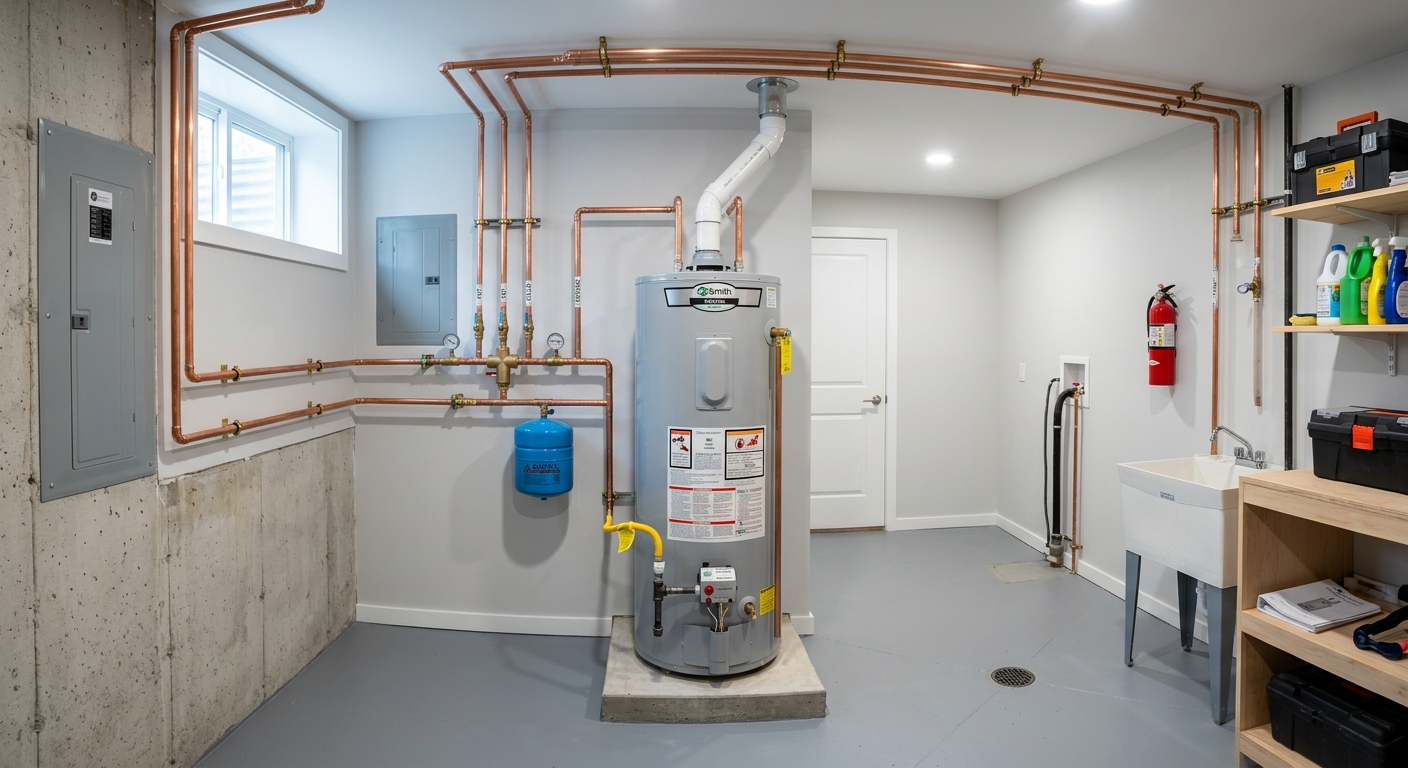
Plumbing services and costs in Hope
Hope, British Columbia has a distinct plumbing mix: many homes are older, yet winters are mild with cold snaps that can still freeze exposed or shallow lines. In Hope’s housing stock, 48.0% of homes were built before 1981 (Statistics Canada, 2021 Census), which increases the odds of legacy galvanized piping and dated shut-off valves showing corrosion or restricted flow over time. It also means water-heater replacements are more common than in newer subdivisions, especially when mineral scale and age combine.
In the Lower Mainland–Southwest region, plumbing pricing is shaped by a “freeze-prone” pattern: contractors must insulate or heat-trace exterior runs and protect lines in garages, crawlspaces, and exterior walls, even though the coast nearby stays comparatively mild. At the same time, variable water hardness across the region can accelerate scale buildup in tank-type heaters and clog fixture aerators, driving service calls sooner. Availability can also affect cost—when multiple crews are booked for weather-driven emergency work, non-urgent repairs may take longer to schedule, but the labour rate typically stays within the same regional band.
In Hope, trade demand is especially steady around the more established residential pockets off Lougheed Highway and the town core, where older homes and add-on renovations are common. If you’re budgeting for an issue like a burst line, a failing heater, or repiping, the comparison below will help you sanity-check quotes before you book a visit.
| Service |
What's Included |
Typical Duration |
Price Range |
| Emergency repair (burst pipe, active leak) |
Locate leak, shut off/winterize area, repair section or replace fittings, pressure test, cleanup and dry-in guidance |
2–8 hours (often longer if water damage is extensive) |
$150–$700 |
| Water heater replacement (tank, 40–60 gallon) |
Remove old unit, install new tank heater, gas or electric hook-up, venting/controls checks, start-up testing |
4–8 hours |
$1,400–$3,500 |
| Tankless water heater installation |
Install tankless unit, upgrade/confirm gas supply or electrical capacity, flush and commissioning, venting checks |
1–2 days |
$2,200–$5,800 |
| Full-home repipe (supply lines, PEX) |
Plan route, remove legacy piping, install PEX/copper-ready layout, new shut-offs and pressure/temperature considerations, system pressure test |
2–5 days (varies with access) |
$3,500–$18,000 |
| Drain snaking / hydro-jetting (blocked drain) |
Camera inspection (if needed), snake/jet, clear stoppage, confirm drainage, advise on ongoing root or pipe issues |
1–4 hours |
$300–$1,400 |
| Backwater valve installation |
Inspect discharge/lowest fixtures, install and test backwater valve, confirm venting considerations and operation |
4–10 hours |
$800–$2,200 |
Prices are estimates only and vary by project scope, site access and material selection.
What affects the price of plumbing in Hope
In Lower Mainland–Southwest and across British Columbia, two plumbers can quote the “same” plumbing problem 30–50% apart because the real work is often in the hidden part: how hard it is to access pipe runs, whether materials must be opened up, and whether the job becomes repair-plus remediation instead of a simple fix. In Hope, where many properties are older—74.0% of dwellings are single-detached (Statistics Canada, 2021 Census)—service often means moving through attics, crawlspaces, exterior walls, and sometimes slab-adjacent lines, which increases time for protection and patching.
Freeze risk also changes pricing. Because cold snaps can still occur even in coastal areas, supply lines running outdoors or through garages often need to be buried deeper than ideal and/or insulated and heat traced. If insulation is missing or the line is too shallow, labour shifts from “replace a section” to “winterize properly,” pushing repairs toward the higher end of the $150–$700 repair band when emergency call-outs are involved. Water hardness adds another variable: harder water is linked with faster heater scaling and fixture buildup. In practical terms, scaling can shorten tank heater life and drive maintenance—so replacement may be recommended sooner, landing you in the $1,400–$3,3,500 range depending on tank size and fuel type.
Older regional housing also matters for materials: galvanized steel can corrode and restrict flow over time; poly-B (polybutylene), particularly from the 1980s to mid-1990s era, can fail at fittings and crack. For an older Hope home, you might start with a low-pressure complaint that turns into repiping discussions, which can quickly move from a $150–$700 diagnostic repair to multi-day full repipe scope such as $3,500–$18,000.
| Price Factor |
Why It Matters |
Cost Impact |
| Type of work — repair vs. replacement vs. new install |
Replacement/new installs require more labour, hookups, and testing |
Repairs can be 20–60% of replacement cost |
| Water heater size and fuel type (gas vs. electric vs. tankless) |
Gas venting, electrical capacity, and water/air piping change install time |
Can shift jobs by 30–100% |
| Pipe material — PEX vs. copper vs. CPVC for repiping |
Material pricing and labour method differ; some homes have mixed legacy pipe |
Higher material cost or more demolition can add thousands |
| Access — pipes in walls or slab require drywall or concrete cutting |
Hidden access drives time, dust control, and patching |
Access can double labour time on the same fixture issue |
| Permit requirement — adds cost and inspection scheduling time |
Permits add administrative steps and delay completion until inspection |
Often adds 1–2 days to scheduling plus permit fees |
| Emergency vs. scheduled — after-hours calls carry a premium |
Urgency requires prioritization, travel time, and risk handling |
Can add 25–75% to labour for repairs |
| Water hardness — affects water heater sizing and descaling needs |
Hard water increases scale; descaling may be needed sooner than expected |
May accelerate replacement vs. repair advice |
| Number of fixtures or drain lines involved |
More locations mean more isolation, testing, and cleanup |
Each additional fixture line adds incremental labour |
Permits & regulations in British Columbia
In British Columbia, most plumbing work beyond simple fixture replacement must be done by a licensed plumber. In general, permits are commonly required for work that affects the municipal water or sewer connections, includes new drain connections, involves full repiping, or changes a water-heater setup in jurisdictions where changeouts trigger inspection requirements. Backwater valve installation is also typically a permit-and-inspection item in flood-prone coastal regions because it changes how sewage is prevented from entering the home. Because requirements can vary by scope and municipality, the safest approach in Hope is to ask your contractor whether a permit is required for your specific address before any work starts.
Step-by-step, homeowners in Hope can verify a contractor’s qualifications:
- Check the plumber’s licence status: look up the British Columbia plumber in the online public registry for a valid journeyman or master plumber number.
- Request proof of liability insurance: ask for a current certificate of insurance showing coverage limits and the business name.
- Confirm WSIB/WCB coverage: ask for clearance documentation or a policy confirmation letter indicating they are registered and covered for workers.
- Require the permit number (if applicable) before work begins so you can confirm inspections are scheduled.
- Get the quote and scope in writing and ensure the permit responsibility is clearly stated (who pulls it).
If a contractor can’t provide licence and insurance documentation promptly, treat that as a red flag—especially for repiping and drain work where access and risk are higher.
Common plumbing problems in Hope homes and how to fix them
Hope’s common plumbing issues largely come down to two themes: freeze-prone exposure during cold snaps and aging pipe materials. First, burst or frozen pipes typically happen when shut-off valves, exterior lines, or shallow runs in garages and crawlspaces aren’t insulated or heat traced. Prevent this by insulating vulnerable sections and adding heat trace where recommended; if a freeze happens, shut off water, protect the area, and call an emergency plumber to locate the damage and pressure test before restoring service.
Second, aging pipe materials can quietly worsen. Galvanized steel can corrode and restrict flow, causing discolouration and recurring low pressure. Poly-B failures often show up at fittings (cracked or failed connections), so homeowners may see intermittent leaks before a sudden burst. For older neighbourhood homes (especially those with major additions), proactive repiping can be the smarter option versus repeated repairs—particularly when you’re already opening walls for one problem.
Third, water heater end-of-life is common because mineral scale and age reduce efficiency. If you’re on hard water, tank-style units often develop scaling that increases maintenance and shortens useful life; a tankless unit can sometimes be a better fit if the home’s venting and gas/electrical capacity support it. Fourth, low water pressure throughout the home is usually aerator clogging, municipal pressure issues, or corroded supply lines—plumbers diagnose with measured pressure at fixtures and supply shut-offs.
Fifth, drain issues in older Hope homes are frequently root intrusion, degraded cast-iron/clay sections, or simple blockages. Hydro-jetting can clear many blockages, but recurring backups after clearing often signal a liner or replacement need.
As a dollar example: clearing a typical blocked drain may be within a $150–$700 repair band when it’s straightforward. If a camera inspection shows recurring root intrusion requiring a longer drain replacement scope, you may be looking at a $3,500–$18,000 range project; that’s where spending on proper diagnostics pays off.
| Issue |
Common Cause in Hope |
Typical Fix |
Price Band |
| Burst or frozen pipe |
Exterior/garage/crawlspace lines insufficiently insulated during cold snaps; shut-offs freezing |
Locate and repair leak, replace damaged section, pressure test, winterize affected runs |
$150–$700 |
| Low water pressure throughout home |
Corroded galvanized supply lines, partially clogged shut-offs, or fixture aerator build-up |
Isolate and test pressures, clean aerators, service shut-offs, consider supply-line repair/repiping |
$250–$1,500 |
| Slow or blocked drain |
Hair/grease buildup, tree-root intrusion, or older drain material deterioration |
Snake or hydro-jet, camera inspection, recommend targeted repair or replacement if failing sections found |
$300–$1,400 |
| Leaking or failed water heater |
Tank corrosion/age; scaling from mineral content; failing thermostat or pressure relief issues |
Replace heater, flush system as appropriate, confirm venting/controls and restore safe operation |
$1,400–$3,500 |
| Poly-B pipe failure (fitting or pipe crack) |
Legacy poly-B fittings degrading or cracking, often seen in homes from the 1980s–1990s era |
Locate failure points, replace affected sections; if widespread, recommend full repipe to modern materials |
$3,500–$18,000 |
| Galvanized pipe corrosion (restricted flow, discolouration) |
Internal corrosion narrowing pipes; mineral deposits; discoloured hot/cold water |
Repair localized sections if minor; otherwise full repipe to PEX/copper for long-term flow restoration |
$3,500–$18,000 |
How to choose a plumbing contractor in Hope
Choosing a plumber in Hope is mostly about verification and clarity. Start by confirming the company uses licensed tradespeople in British Columbia: ask for the plumber’s licence number and check it in the public online registry. Next, request a certificate of liability insurance—this should match the legal business name and be current. Then confirm workers’ coverage: in practice, contractors should be registered and covered through WSIB/WCB arrangements, and they should provide clearance or documentation on request.
For pricing, get 2–3 itemised written quotes, not a lump sum. The best quotes break labour (diagnosis time, installation time, testing) and materials (heater model, venting components, pipe and fittings). Carefully read exclusions: ask whether demolition and disposal are included, whether drywall/cutting costs are part of the price, and whether the permit (if required) and any inspection scheduling time are included. For warranty, ask for both workmanship warranty length and the product/manufacturer warranty terms; also confirm if the warranty is transferable to your household.
Finally, manage payment smartly. Never pay more than about 10–15% upfront for labour/material mobilisation; keep a holdback until the job is complete and tested. Insist on a start date and a completion estimate in writing—especially for projects that may require inspection. In Hope, timing matters because cold snaps can turn a “scheduled” repair into an emergency if water supply lines are compromised.
- Confirm the plumber’s BC licence number before work begins.
- Verify liability insurance via certificate (limits and business name).
- Confirm WSIB/WCB coverage and obtain clearance documentation.
- Request 2–3 itemised quotes with labour and material breakdown.
- Ask whether permits are required and who pulls them.
- Check what’s included for disposal and site cleanup.
- Confirm drywall patching or restoration scope (who pays, what’s included).
- Get start date and completion timeline in writing.
- Ask for pressure-test or camera-inspection confirmation where applicable.
- Clarify warranty: workmanship duration, product warranty, and transferability.
- Agree on payment schedule with minimal upfront deposit and a holdback.
- Ensure the quote specifies exact fixtures/heater models and fuel type.
Red flags in Hope: “we don’t need permits,” vague scopes that don’t list parts or disposal, reluctance to provide licence/insurance proof, large upfront payments, or quotes that avoid stating a timeline and warranty terms.
Frequently asked questions — plumbing in Hope
How do I compare plumbing quotes?
Start by comparing apples to apples: ask each contractor for an itemised quote that separates labour, parts/materials, and any diagnostic work (like camera inspection for drains). In Hope, scope can quietly expand—an “unclog” call may turn into work on older drain sections, or low pressure can reveal corroded galvanized supply lines. Make sure each quote states what’s included (pressure testing, start-up testing for heaters, disposal, and any drywall cutting/patching). Also confirm whether permits are required for your situation and who pulls them. For rough budgeting, you can compare to local price bands: simple repairs often fall around $150–$700, while water heater replacements commonly land in the $1,400–$3,500 range. The “best” quote is usually the one with the clearest scope, not just the lowest line total.
How long does a water heater replacement take in Hope?
In Hope, most tank water heater replacements typically take about 4–8 hours, assuming the unit is accessible and the required venting/electrical or gas connections are already in place. If your home is older (many are pre-1981), plumbing may require extra time for safe removal of legacy connections or adjustments to controls—so expect the day to stretch if parts are corroded or fittings are stuck. After installation, a good plumber will test for safe operation, check temperature/relief valve function, and confirm there are no leaks. If your project is a tankless installation, timelines are often longer (commonly 1–2 days) due to venting and utility capacity checks. For budgeting, replacement work generally aligns with the $1,400–$3,500 range, depending on heater type and the complexity of hookup.
What is a backwater valve and do I need one in Hope?
A backwater valve is a one-way device installed in the sewer line that helps prevent wastewater from backing up into your home during heavy flows. In the Lower Mainland–Southwest, where intense rain events and high sewer surcharges can occur, this is particularly relevant for basements and lower-level drains. Many homeowners choose a backwater valve when they have frequent basement dampness, older drainage layouts, or want protection after costly drain backups. In terms of regulations, backwater valve installation typically requires a permit and inspection in BC for work that affects sewer performance, so ask your plumber to confirm the permit process for your address. Pricing commonly sits around the $800–$2,200 range depending on the inlet location and access conditions, and it can be more cost-effective than emergency cleanup if a backup happens.
How do I shut off the water supply in my Hope home?
First, locate your main shut-off valve. In many Hope single-detached homes, it’s near the water meter or where the main line enters the house (often near a utility area, crawlspace access, or mechanical room). Turn the valve fully off clockwise and then open a nearby cold tap to relieve pressure; this confirms the system is actually shut down. If you have multiple shut-offs (for example, one per bathroom or kitchen), you can isolate smaller areas while leaving the rest of the home supplied—useful when a leak is limited to one room. For frozen or burst-pipe events, shutting off water quickly reduces damage, but don’t restart service until the plumber has repaired and pressure-tested the affected section. If you’re unsure where your shut-off is, ask your plumber to point it out during a service visit.
Can I claim a plumbing repair on home insurance in British Columbia?
Sometimes, but it depends on your policy and the cause of the damage. In British Columbia, most insurance claims for plumbing relate to sudden and accidental events—like a burst pipe—rather than ongoing wear and tear or lack of maintenance. For Hope homeowners, freeze-related pipe bursts during cold snaps are commonly the kind of event that insurance may consider if you can document the failure and prove it wasn’t preventable through reasonable maintenance. If there’s an active leak, call a plumber promptly and document the damage before repairs. Keep itemised invoices and any photos from the scene. Note that even when the plumbing repair itself is modest, the restoration costs (drying, flooring, cleanup) can be the major part of the claim. Use local budgeting as context: emergency leak fixing can start around $150–$700, but repairs that expose walls or require restoration can go far beyond that.
How do I prevent drain clogs in my Hope home?
Prevention is usually about reducing what goes into drains and catching issues early. Use a strainer in kitchen sinks to stop grease and food from building up, and avoid flushing hair, wipes, or cooking oil. In older Hope homes, drain systems may include legacy materials that are more vulnerable to root intrusion and slow deterioration; that means “small” backups can worsen faster than in newer builds. Run hot water after greasy loads and use enzyme-based treatments only if your plumber says they’re appropriate for your pipe type—some clogs respond better to mechanical clearing than chemicals. If you notice recurring slow drainage, don’t keep clearing without investigating: ask for a camera inspection to identify whether the issue is blockage versus root intrusion or a failing section. Proactively addressing it can prevent repeated service calls that would otherwise add up over time.