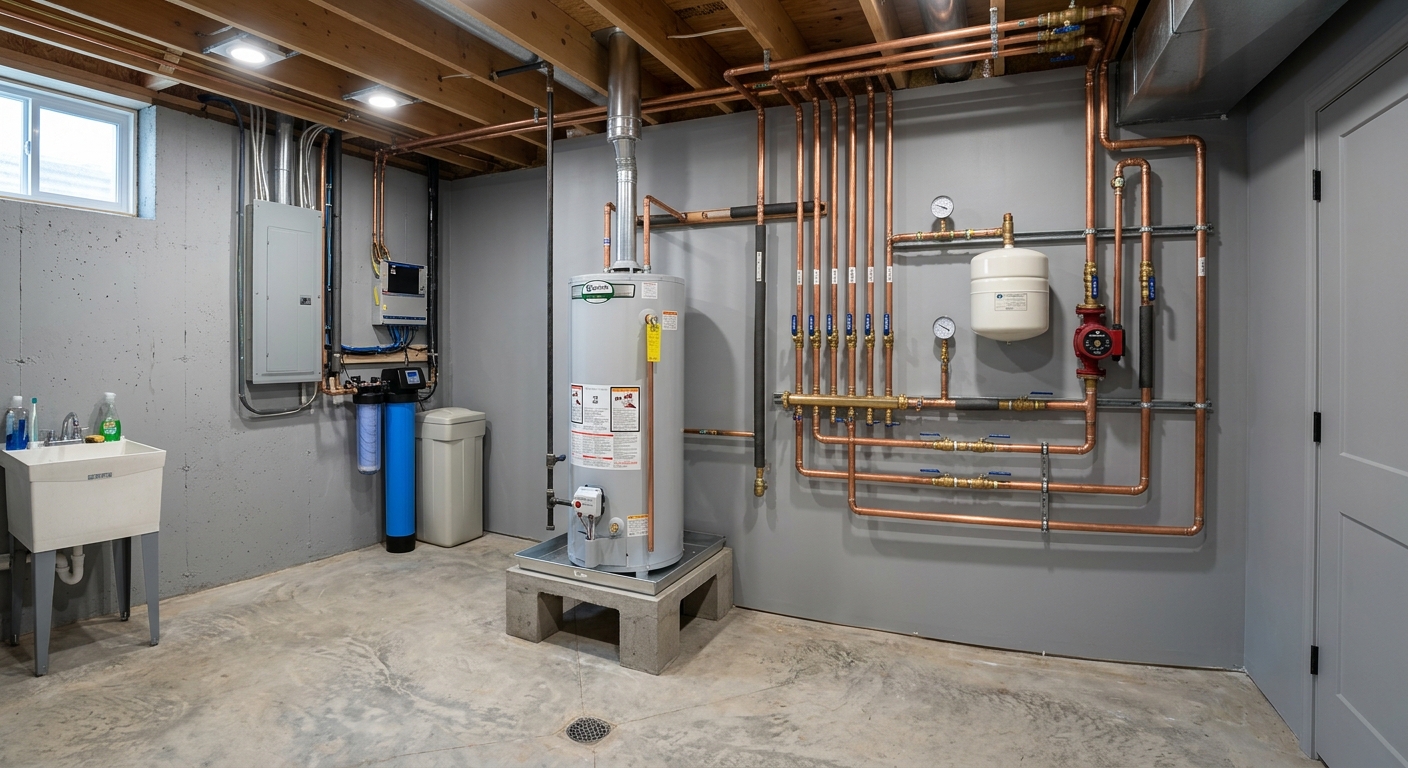
Plumbing services and costs in Kelowna
Kelowna homeowners often notice plumbing costs add up quickly when winters are cold enough to freeze exposed lines and when older homes mean more legacy pipe materials. In Kelowna and the surrounding Thompson–Okanagan region, 31.7% of homes were built before 1981, so plumbers frequently encounter older supply lines and drain systems during routine repairs. That matters because many of these properties eventually need either component replacements (valves, drains, water heaters) or larger projects like repiping, especially once leaks appear in multiple locations. At the same time, 40,250 homeowner households (64.7% of households own) creates steady demand for planned upgrades—particularly water-heater and freeze-prevention work ahead of winter.
Thompson–Okanagan’s climate drives a distinct cost profile. Supply lines running too shallow, poorly insulated in crawlspaces, or located near grade can suffer during sustained sub-zero spells, leading to burst-pipe and freeze-repair callouts. Water chemistry also plays a role: moderately to very hard water accelerates scale buildup in tank units, shortens anode life, and increases the frequency of descaling or heater replacement. Localized construction pressures—tight access in hillside and lakefront neighbourhoods—further affect labour time and materials handling. Trade availability can be strongest in busier service areas like Rutland and Glenmore, where older housing stock and multi-bath layouts increase repeat repair demand.
Below is a practical comparison of common plumbing services you’ll see quoted in Kelowna, so you can line up scope and expectations before calling contractors.
| Service |
What's Included |
Typical Duration |
Price Range |
| Emergency repair (burst pipe, active leak) |
Locate leak, shutoff/temporary water control, pipe repair or replacement section, pressure test, cleanup; drywall access as needed |
2–8 hours (plus monitoring/restoration time if access is extensive) |
$180–$800 |
| Water heater replacement (tank, 40–60 gallon) |
Remove/haul away old heater, install new tank, connect water lines, venting checks, initial flush, leak test, basic commissioning |
4–8 hours |
$1,200–$2,200 |
| Tankless water heater installation |
Site assessment, install unit and gas/electric hookups (as applicable), vent/air intake setup, flush, commissioning, first hot-water verification |
1–2 days |
$2,400–$3,800 |
| Full-home repipe (supply lines, PEX) |
Remove/replace galvanized/legacy lines, new PEX routing, shutoffs, pressure testing, wall/floor access management, restore finishes where feasible |
3–7 days |
$4,500–$15,000 |
| Drain snaking / hydro-jetting (blocked drain) |
Camera inspection (if needed), snake or hydro-jet for stoppage, verify flow, advise on root intrusion or line failure if observed |
1–3 hours (longer if multiple line segments are involved) |
$250–$1,200 |
| Backwater valve installation |
Assess sewer/backflow risk, install valve with required fittings, verify proper orientation and flow direction, test operation, permit/inspection where required |
1 day |
$1,500–$3,200 |
Prices are estimates only and vary by project scope, site access and material selection.
What affects the price of plumbing in Kelowna
In Kelowna, the same “category” of job can come in with a 30–50% difference between quotes across the Thompson–Okanagan region and broader British Columbia. The biggest drivers are how much labour time is hidden until the plumber opens walls, how complex the pipe routing is (older homes often have surprises), and whether parts of the job become replacement work once the contractor discovers failing materials. A simple leak may stay in the $180–$800 repair band, but if it turns out the leak is tied to restricted galvanized lines or a failing connection behind finished drywall, the quote can quickly move toward repipe territory.
Freeze risk is the key climate variable here. In much of the Thompson–Okanagan, frost depth determines whether outdoor or garage supply lines need deeper burial, insulation, or heat trace cable. If a line was run shallow or insulation was missing, winter can push the project into emergency work and multi-day repairs because the plumber may need to thaw, isolate, and replace sections safely. Water hardness also varies across British Columbia: hard water commonly accelerates tank water-heater scale buildup, which can reduce efficiency and shorten anode life by roughly 20–30%. That means descaling service and heater replacement calls become more frequent, and you’ll often see higher demand for replacements within the $1,200–$2,200 tank-heater range.
Housing-stock details create additional price swings. Homes from the 1980s to mid-1990s may still include poly-B pipe with known fitting-related failure risks, and many older properties include galvanized steel that restricts flow over time. In Kelowna, “looks fine” pipe can still be corroded inside—so testing and camera/pressure checks are what determine whether you’re doing an isolated repair or moving to a full replacement approach.
| Price Factor |
Why It Matters |
Cost Impact |
| Type of work — repair vs. replacement vs. new install |
Replacement and new installs usually involve teardown, new components, and longer commissioning/testing |
Repair can stay near $180–$800, while replacement jobs commonly climb toward $1,200–$2,200 or higher |
| Water heater size and fuel type (gas vs. electric vs. tankless) |
Different venting/electrical requirements and higher input ratings change labour and materials |
Tank installs often fit the $1,200–$2,200 band; tankless typically costs more |
| Pipe material — PEX vs. copper vs. CPVC for repiping |
Material cost and labour complexity vary, and some homes require specialty transitions |
PEX repipes often price mid-to-high within the repipe band; copper can push the high end |
| Access — pipes in walls or slab require drywall or concrete cutting |
Access dictates time, patching needs, and disposal |
Hidden access can turn a shorter job into a multi-day project, increasing labour costs significantly |
| Permit requirement — adds cost and inspection scheduling time |
Inspections can delay timelines; paperwork and compliance steps take staff time |
Often a noticeable increase; can add scheduling overhead and minor direct permit fees |
| Emergency vs. scheduled — after-hours calls carry a premium |
Priority dispatch, after-hours labour premiums, and on-site troubleshooting change the economics |
Emergency work commonly increases your cost versus planned repairs |
| Water hardness — affects water heater sizing and descaling needs |
Hard water increases scale, impacting heater efficiency and service frequency |
May justify upgrades or routine maintenance earlier than expected |
| Number of fixtures or drain lines involved |
More branches = more joints, more testing, and more camera time |
Scope creep from “one drain” to multiple lines is a common reason quotes rise |
Permits & regulations in British Columbia
In British Columbia, most plumbing work beyond simple fixture replacement must be performed by a licensed plumber. As a Kelowna homeowner, think of permits as applying when the work meaningfully changes the plumbing system—especially where it connects to water or sewer services. In general, work that typically does require a permit includes: new drain connections, any change or addition to a home’s water or sewer connections, full or partial repiping that alters piping routes, water heater changeouts in many situations (and always when required by the municipality or the scope triggers inspection), and installations like backwater valves that protect against sewer backup.
Work that typically does not require a permit is often basic replacement of existing fixtures (for example, swapping an existing shower trim or a toilet with the same rough-in), provided you’re not moving drain/water connections and you’re staying within the existing plumbing configuration. Because rules can be triggered by scope, always confirm the permit requirement when the plumber writes the job description.
To verify your contractor in Kelowna, follow a simple checklist: (1) confirm the plumber holds a valid BC licence (look for their licence number and status in the online registry), (2) ask for a certificate of insurance and confirm it includes liability coverage, (3) request proof of WCB coverage (or the equivalent documentation they provide) for their workers, and (4) ensure the written scope states what permits will be pulled and who schedules inspections. For backwater valves, ask directly whether a permit and inspection are included—good contractors will spell it out.
Common plumbing problems in Kelowna homes and how to fix them
Kelowna’s housing stock and climate produce a predictable set of plumbing problems. The first is burst or frozen pipes. It often starts with exposed or shallow supply lines in crawlspaces, near garage walls, or outdoors—especially when insulation was minimal. Prevention is practical: insulate vulnerable runs, add heat trace where the pipe can’t be relocated deeper, and keep cabinet doors open on the coldest weeks. If a burst happens, response is time-sensitive: shut off the water, protect electrical areas, and call an emergency plumber to locate the break, then pressure-test before closing up.
Second, aging pipe materials drive chronic issues. Galvanized steel can corrode internally, restricting flow and discoloring water, while poly-B can suffer from brittle fittings or cracking. In Thompson–Okanagan homes built in the later decades of the last century, these materials can fail in clusters—so proactive planning can prevent multiple emergency calls. As a reference point, a repair may start in the $180–$800 band, but once you’re opening walls or replacing several runs, repipe work often becomes more cost-effective within the $4,500–$15,000 range.
Third, water heater end-of-life is common due to hard water scaling. Tank units (often in the $1,200–$2,200 install band) typically need more maintenance and sooner replacement when mineral buildup is heavy. Tankless can be a better investment where you want longer-term hot-water consistency and you’re ready for the right venting/electrical or gas setup—especially if your system is sized correctly for your household.
Fourth, low water pressure is frequently caused by clogged aerators, scale inside supply lines, or corroded galvanized piping. Plumbers diagnose using shutoff pressure checks, filter/aerator inspection, and—when needed—line flushing or camera/flow testing.
Fifth, drain issues in older Kelowna homes often come from blockage, root intrusion, or failed cast-iron sections. The right fix depends on whether the drain is blocked (snaking/hydro-jetting) versus structurally compromised (spot repair or replacement).
| Issue |
Common Cause in Kelowna |
Typical Fix |
Price Band |
| Burst or frozen pipe |
Exposed supply lines near exterior walls/garages, shallow runs in older homes, insufficient insulation |
Shutoff and locate leak, replace damaged section, thaw safely, pressure test, insulation/heat-trace upgrade |
$180–$800 |
| Low water pressure throughout home |
Clogged aerators, scale buildup, restricted galvanized lines, or pressure drop issues |
Clean/replace aerators and filters, flush lines, evaluate shutoff/pressure regulator, recommend repiping if restricted |
$250–$1,500 |
| Slow or blocked drain |
Hair/grease buildup, partial obstruction, and root intrusion in older drain runs |
Snake or hydro-jet, camera inspection, address root intrusion with follow-up repairs if needed |
$250–$1,200 |
| Leaking or failed water heater |
Hard-water scaling, shortened anode life, older tank age |
Replace tank, confirm venting/pipe connections, flush system and verify safe operation |
$1,200–$2,200 |
| Poly-B pipe failure (fitting or pipe crack) |
Fitting-related failures and brittleness in legacy poly-B systems common to 1980s–1990s builds |
Isolate affected sections, repair fittings where safe; recommend repipe if multiple failures occur |
$1,500–$15,000 |
| Galvanized pipe corrosion (restricted flow, discolouration) |
Internal corrosion reducing flow, rusty/discoloured water, deposits from hard water |
Flush and test, replace sections where limited; recommend repiping when flow is broadly restricted |
$1,500–$15,000 |
How to choose a plumbing contractor in Kelowna
Choosing the right plumber in Kelowna starts with verification. Ask for the contractor’s British Columbia licence number and confirm it on the BC online registry (a legitimate pro will provide it without hesitation). Next, request proof of liability insurance—if they can’t supply a certificate of insurance, don’t proceed. Finally, ask for documentation of WSIB/WCB coverage for their workers (or the appropriate coverage they provide), so you’re not left holding the cost if a worker is injured on your property.
For pricing, get 2–3 itemised written quotes, not a single lump-sum number. The best quotes break out labour and materials, explain what’s included in diagnostics, and state whether drywall/concrete restoration is included or billed separately. Read the scope for exclusions: does it include permit pulling and inspection scheduling (where applicable), waste disposal, and any camera inspection for drains? Warranty should also be clear. Ask how long the workmanship warranty lasts, what the manufacturer warranty covers, and whether the warranty is transferable to you if you sell the home.
Payment structure matters in Kelowna. A common safe approach is never paying more than 10–15% upfront, then holding back the remainder until the job is complete and cleaned up. Make sure your timeline includes a start date and an estimated completion window in writing, especially for jobs affected by inspection scheduling or winter freeze-prevention constraints.
- Confirm BC licence number and status before work begins.
- Verify liability insurance via certificate of insurance (not just a promise).
- Request proof of WSIB/WCB coverage for workers.
- Get 2–3 itemised quotes with labour and materials clearly separated.
- Ask if permit pulling and inspections are included in the quoted scope.
- Confirm disposal/haul-away is included (especially for old heaters or pipe waste).
- Ask whether camera inspection is included for drain issues.
- Ensure the quote lists the exact parts proposed (heater type, valves, pipe size/material).
- Check warranty terms: workmanship duration, manufacturer coverage, transferability.
- Use a payment schedule with at most 10–15% upfront; keep a holdback.
- Get a written start date and completion estimate, including contingency time for access issues.
- Request references from similar Kelowna projects (older homes, winter emergency work, drain replacements).
Red flags to watch for in Kelowna include: refusing to provide a licence number or insurance documents, quoting a low price but omitting permit/inspection costs in the scope, giving only a verbal estimate without line items, demanding large upfront deposits, and not explaining what happens if additional failures are discovered behind walls or under slabs.
Frequently asked questions — plumbing in Kelowna
What causes hard water and how do I treat it?
In Kelowna and much of the Thompson–Okanagan, “hard water” usually comes from the minerals in the water supply (commonly calcium and magnesium). You’ll see it as mineral deposits on shower heads, soap scum that feels “sticky,” and faster scaling inside tank water heaters. The practical treatment path is: first, confirm the issue by checking for limescale patterns and (if needed) water analysis; then consider a whole-home softener or a water-heater-specific solution like descaling/maintenance scheduling. If you’re replacing a heater, upsizing maintenance planning matters—hard water can shorten anode life and push replacements sooner. For reference, a typical tank water-heater installation in Kelowna often lands in the $1,200–$2,200 band, and treating scale can protect the new unit. In any case, your plumber can recommend equipment suited to your household size and usage.
How long does a water heater last in Kelowna?
In Kelowna, the lifespan of a water heater depends heavily on water chemistry and maintenance. With moderately to very hard water, tanks accumulate scale, which reduces efficiency, stresses components, and can shorten effective service life. Many homeowners replace a failing tank sooner than expected when you see symptoms like inconsistent hot water, rumbling sounds (sediment), or leaks around the base. While exact years vary by model and usage, planning for earlier replacement than you might in softer-water areas is common in the Thompson–Okanagan. When you’re ready to replace, a standard tank replacement often fits the $1,200–$2,200 band, while tankless installs typically cost more due to venting and system requirements. A good approach is to have a plumber check anode condition and estimate remaining life before you’re faced with an emergency during winter cold snaps.
What should I do about a burst pipe?
If you have a burst pipe in Kelowna, act fast: shut off the main water if you can do so safely, protect any electrical outlets, and minimize water damage by moving valuables away from the leak area. Then call an emergency plumber to locate the break and make a proper repair (not just a temporary patch), followed by pressure testing. Winter freeze risk in our area means supply lines can fail in hidden spaces like crawlspaces, exterior walls, and some garage runs—so expect a careful access plan. After the repair, ask the plumber to identify why the pipe froze or failed and whether insulation, heat trace cable, or deeper routing is needed to prevent a repeat. Emergency repairs are commonly priced in the $180–$800 range for straightforward fixes, but extensive access or multiple sections can push the final cost higher.
Poly-B or galvanized pipes — should I replace them?
Whether to replace poly-B or galvanized pipes in a Kelowna home depends on condition, age, and how widespread the problem is. Galvanized steel often shows internal corrosion over time, leading to restricted flow and discoloured water; if pressure is down across multiple fixtures, spot repairs rarely solve the root issue. Poly-B can fail at fittings and joints, and once you’ve had one failure, the risk of additional leaks can rise—especially in older systems common to 1980s–mid-1990s builds. If only a single, accessible section is affected, your plumber may offer a localized repair, but if failures are clustered or you’re already opening walls for one leak, repiping can be more cost-effective. Repiping supply lines with PEX can range widely and often sits within $1,500–$15,000 depending on how many runs need replacement and how much access work is required.
How do I compare plumbing quotes?
When comparing plumbing quotes in Kelowna, don’t just compare the bottom-line number—compare what’s included. Ask for itemised pricing that separates labour and materials, and confirm whether a permit is included for the work that connects to water or sewer systems. Make sure the scope clearly states diagnostics (for example, camera inspection for drains), disposal/haul-away, and whether drywall or concrete cutting is part of the price. For water heaters, confirm the exact model type and whether venting checks and leak testing are included. For emergency work, ask about after-hours premiums and what access is expected. As a practical guide, straightforward emergency leak fixes can fall in the $180–$800 band, while tank heater replacement commonly lands in the $1,200–$2,200 range. Quotes that are far below those ranges often omit parts of the scope or require add-ons later—so read the exclusions carefully.
How long does a water heater replacement take in Kelowna?
In Kelowna, a typical tank water-heater replacement usually takes most of a day, often around 4–8 hours depending on access, venting complexity, and whether supply/vent connections need additional work. If the existing heater is in a tight space or if the plumber discovers corroded fittings once the unit is removed, the timeline can extend. For tank replacements, plan for contractor time plus small delays associated with verifying safe operation, flushing as required, and confirming no leaks after installation. The climate angle matters too: doing the job efficiently reduces the time you’re without hot water during colder periods. Many installs fall into the $1,200–$2,200 band for typical tank work, but your plumber will confirm what’s included (removal/haul-away, new connections, and basic commissioning) before scheduling. Tankless installs generally take longer because they require additional system work.