Plumbing services and costs in Lake Country
Plumbing in Lake Country has its own rhythm: between freezing nights in winter, moderately to very hard water, and a sizable portion of older homes, homeowners often find that small leaks can become urgent fast. In Lake Country, Statistics Canada reports 28.3% of dwellings were built before 1981, and those properties are more likely to include legacy materials and older plumbing layouts. Just as importantly, Thompson–Okanagan’s winter freeze risk affects how deep exterior supply lines and any crawlspace plumbing must be installed, insulated, and sometimes heat-traced—especially on hillside and lakefront properties where access is tight and the weather can shift quickly.
The local housing mix also shapes when you’ll see contractors available: routine replacements and drain work can be scheduled, but burst-pipe calls spike during prolonged sub-zero stretches. That demand pattern can add a small premium for after-hours or emergency dispatch, and it can impact turnaround times if multiple calls hit the same neighbourhood. In Lake Country, areas with older stock and more exposed exterior runs—commonly around Rae Road and the older core near the lakefront—tend to see more freeze-related troubleshooting.
Below is a practical cost comparison of the services Lake Country homeowners most often request, so you can budget before you call. Use it to sanity-check quotes and to understand what changes the price most: urgency, access, and whether the job is a repair versus a replacement.
| Service |
What's Included |
Typical Duration |
Price Range |
| Emergency repair (burst pipe, active leak) |
Locate leak, shutoff/containment, temporary repair or reroute, pressure test, cleanup |
2–8 hours (often same day) |
$180–$800 |
| Water heater replacement (tank, 40–60 gallon) |
Remove/haul away old unit, install new tank, new valves/connections as needed, test & startup |
4–8 hours |
$1,200–$2,200 |
| Tankless water heater installation |
Site assessment, install unit, venting/condensate setup as required, gas/electric tie-in, commissioning |
1–2 days |
$1,900–$3,800 |
| Full-home repipe (supply lines, PEX) |
Remove old piping as required, install new PEX supply, isolate/replace shutoffs, pressure test, restore access |
3–7 days |
$4,000–$12,500 |
| Drain snaking / hydro-jetting (blocked drain) |
Camera inspection or determine blockage, mechanical clearing and/or hydro-jet, verify flow |
1–4 hours |
$180–$1,500 |
| Backwater valve installation |
Assess sewer routing, install backwater valve, sealing/connection, test & verify discharge direction |
3–6 hours |
$1,200–$2,900 |
Prices are estimates only and vary by project scope, site access and material selection.
What affects the price of plumbing in Lake Country
For the same basic plumbing problem, quotes can vary by 30–50% across Thompson–Okanagan and the broader province because of a few repeat drivers: freeze conditions that require deeper installation and insulation, differences in local access (slabs, crawlspaces, and finished walls), and whether the plumber is doing a straightforward repair versus replacing failing systems. In British Columbia, scheduling and labour rates also move with demand—winter emergencies can pull crews off planned work for days.
Freeze risk sets how deep exterior supply lines must be run and how protected they are. In colder stretches, shallow runs that are poorly insulated can trigger burst-pipe and freeze-repair calls. That often increases the scope immediately: heat tracing may be added, and damaged sections can extend farther than expected. Water chemistry adds another cost layer: in many parts of BC, hard water accelerates scale buildup in tank water heaters, shortens anode life, and increases mineral deposits on fixtures. That can push replacement timing forward and makes descaling service more frequent. Where you have older housing stock—like many homes built before 1981—galvanized supply lines can also restrict flow over time.
Concrete examples in Lake Country: (1) A “small” active leak behind a wall may start at a single fitting, but once the pipe is corroded or insulation is saturated, plumbers may need to open more drywall to reach sound metal—raising you from the repair band (about $180–$800) toward broader work. (2) If you’re seeing repeat heater issues on hard-water mornings and the unit is already aged, replacing sooner can be more cost-effective than repeated callouts; a tank replacement typically falls around $1,200–$2,200, while full repiping carries a much larger range when multiple runs are failing.
| Price Factor |
Why It Matters |
Cost Impact |
| Type of work — repair vs. replacement vs. new install |
Repairs are smaller localized scopes; replacements often include removal, testing, and code-matching parts |
Often drives 20–40% swings |
| Water heater size and fuel type (gas vs. electric vs. tankless) |
Fuel type changes venting/electrical/gas work; size affects labour, parts, and vent/pipe sizing |
Can add hundreds to several thousand dollars |
| Pipe material — PEX vs. copper vs. CPVC for repiping |
Material choice affects cost, connector pricing, and how much access is needed to match existing lines |
Commonly shifts repipe budgets materially |
| Access — pipes in walls or slab require drywall or concrete cutting |
Hidden piping needs selective opening and restoration; slabs can require more labour and patching |
May double labour portion on difficult layouts |
| Permit requirement — adds cost and inspection scheduling time |
Work tied into water/sewer systems or full repipes typically requires inspections |
Can add time and administrative costs |
| Emergency vs. scheduled — after-hours calls carry a premium |
Winter emergencies often require dispatch, priority access, and sometimes temporary bypass solutions |
Usually raises repair pricing on the high side |
| Water hardness — affects water heater sizing and descaling needs |
Hard water increases scale on tanks, reduces efficiency, and increases fixture buildup |
May accelerate replacement frequency |
| Number of fixtures or drain lines involved |
More stops/lines mean more access points, more testing, and more “find the cause” time |
Greater scope increases total project cost quickly |
Permits & regulations in British Columbia
In British Columbia, most plumbing work beyond simple fixture swaps must be completed by a licensed plumber, and permits are commonly required for work that changes or connects to the building’s water or sewer services. As a homeowner in Lake Country, you should expect permits for things like new drain connections, changes to venting/vent terminations, water-heater changeouts in some municipalities, full repiping, and any work that ties into the municipal water or sewer system. Backwater valve installation is also typically treated as a permit/inspection item, since it changes how sewer flows behave and must be installed and tested correctly.
Simple “like-for-like” fixture replacement (for example, replacing a showerhead or faucet without altering plumbing connections) is often handled as a smaller job, but once hoses, supply lines, drains, vents, or shutoffs are altered—or when the work could affect service connections—assume a permit may be needed. The safest approach is to ask the plumber to confirm permit requirements in writing before starting.
To verify your contractor: (1) check the BC licence status using the online licence registry for the journeyman/master plumber referenced on the quote; (2) request a current certificate of insurance showing liability coverage—confirm it matches the business name on the quote; (3) ask for proof of coverage for workplace obligations (WSIB/WCB) where applicable; (4) request a written scope that states whether the plumber will pull the permit and schedule inspections. If they can’t provide licence details or insurance documentation up front, treat it as a red flag.
Common plumbing problems in Lake Country homes and how to fix them
Lake Country’s older housing stock and Thompson–Okanagan winter conditions create a predictable set of plumbing issues. Here are five of the most common problems and how they’re typically addressed, with the “why” tied to climate and materials you’ll see locally.
(1) Burst or frozen pipes: In sub-zero stretches, poorly insulated exterior runs, shallow garage lines, and lines tucked too close to grade are vulnerable. Prevention means insulating exposed piping, sealing exterior penetrations, and—where a home has a history of freezing—installing heat trace and adding insulation to match local conditions. If it happens, the emergency move is shutting off water, locating the frozen/burst section, and applying repairs quickly; delaying turns a manageable leak into water damage.
(2) Aging pipe materials: Galvanized steel can corrode internally, restricting flow and trapping sediment. Poly-B (polybutylene), where present from the 1980s to mid-1990s era, can become brittle and fail at fittings. For these, proactive repiping often beats repeated patch jobs. A full repipe can be a large budget item, but if multiple fixtures show staining, you’ve had recurring leaks, or pressure is inconsistent house-wide, replacing the system can be more cost-effective than “one leak at a time.”
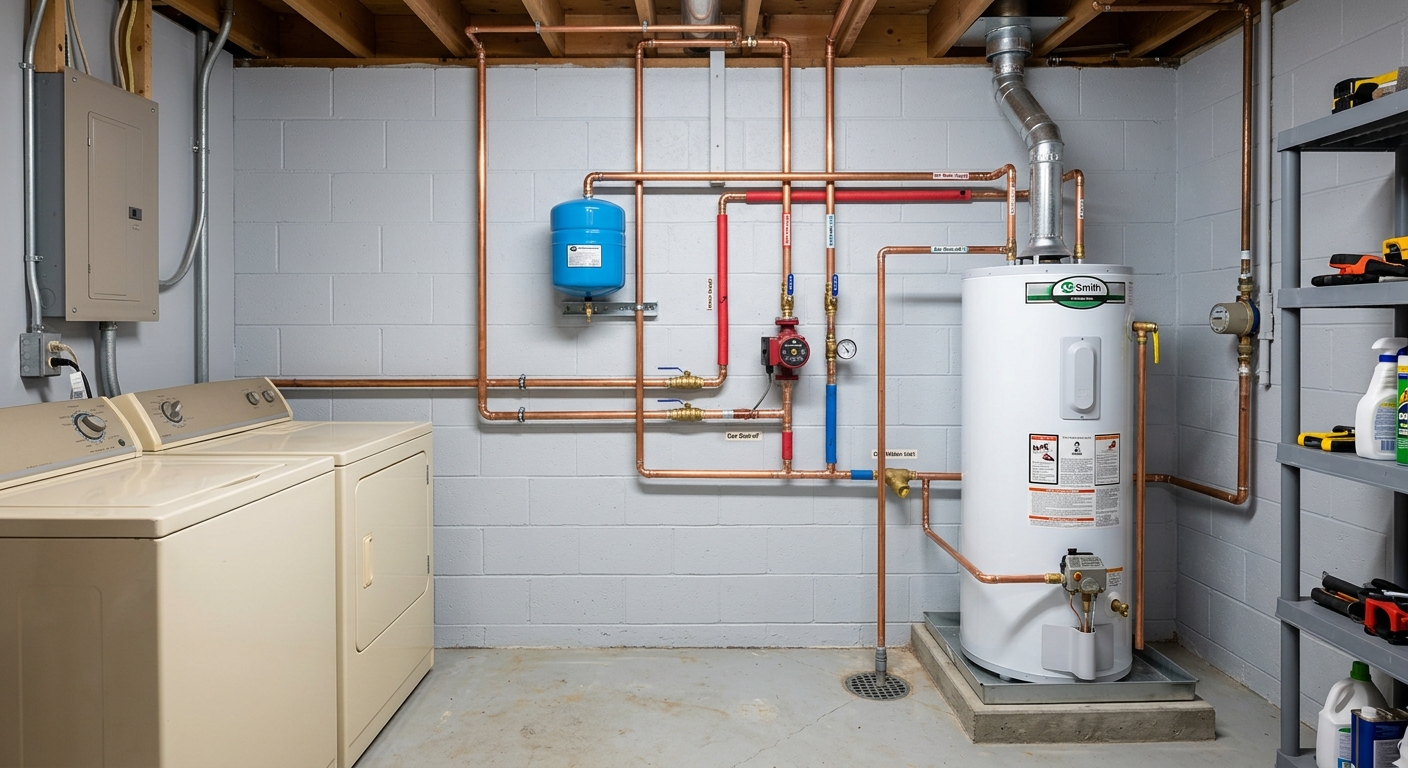
(3) Water heater end-of-life: In hard-water conditions, tank water heaters scale faster and anodes don’t last as long, pushing replacement needs sooner. A tank replacement in the typical band is around $1,200–$2,200; tankless can be a strong long-term option when sized correctly, but installation complexity and venting requirements can increase the upfront cost.
(4) Low water pressure: Common causes include clogged aerators, corroded galvanized lines, partially blocked shutoffs, or sediment buildup. Plumbers diagnose by checking pressure at the source, testing individual fixtures, and inspecting where scale accumulates.
(5) Drain issues: Slow drains can be straightforward blockages, but older homes also see root intrusion into sections of cast-iron or older drain runs. The right fix depends on whether it’s a blockage, intrusion, or failed pipe material. For example, a snaking/hydro-jet job may be justified first, but if camera inspection shows root intrusion or cracks, partial drain replacement can be the real solution.
Where the price difference is worth it: if a blocked main drain costs roughly $180–$1,500 to clear, but the underlying cause is recurring root intrusion, paying for a camera-backed plan can prevent repeated cleanouts and shorten downtime.
| Issue |
Common Cause in Lake Country |
Typical Fix |
Price Band |
| Burst or frozen pipe |
Exterior runs or garage/crawlspace lines without sufficient insulation; sub-zero freeze |
Locate leak, thaw/contain if frozen, replace damaged section, insulate/heat-trace as needed |
$180–$800 |
| Low water pressure throughout home |
Corroded galvanized supply, partially closed shutoffs, sediment buildup, pressure drop |
Test at main, inspect shutoffs, flush/clear lines, repair restrictions or repipe if widespread |
$250–$1,500 |
| Slow or blocked drain |
Built-up grease/hair; root intrusion in older drain sections |
Snaking or hydro-jetting; camera inspection; repair/replace affected drain sections |
$180–$1,500 |
| Leaking or failed water heater |
Tank wear from hard-water scaling; anode depletion; age-related failure |
Replace tank; adjust valves/relief setup; verify venting and startup performance |
$1,200–$2,200 |
| Poly-B pipe failure (fitting or pipe crack) |
Brittle fittings and leaks developing around joints; older 1980s–mid-1990s builds |
Identify affected runs; sectional replacement or repipe if failures are widespread |
$1,500–$8,500 |
| Galvanized pipe corrosion (restricted flow, discolouration) |
Internal rust scale reducing flow; mineral staining from corrosion products |
Flush/clear if localized; replace affected sections or full repipe if multiple fixtures impacted |
$1,500–$15,000 |
How to choose a plumbing contractor in Lake Country
Choosing the right plumber in Lake Country starts with verification. First, confirm the contractor’s British Columbia licence: look for the licence number and the named journeyman/master on the quote and invoice, then cross-check it in the BC licence registry. Next, request a certificate of insurance that shows liability coverage and verify the business name matches what’s on the quote. For workplace coverage, ask for WSIB/WCB clearance or proof of coverage where applicable—legitimate operators can provide documentation without pushing back. If they won’t provide licence and insurance details before you approve work, move on.
Then get 2–3 itemised written quotes. You want a breakdown that separates labour, materials, disposal/haul-away, and any testing or camera inspection. Avoid “one-line” lump sums because they hide scope gaps—like whether the plumber will pull a permit, whether drywall/concrete access and restoration is included, and whether parts are included at retail or discounted pricing.
Warranty matters: ask for the workmanship warranty length and whether it covers call-backs related to installation. Also confirm the manufacturer warranty for the specific product model and whether it’s transferable to the homeowner. For payment, never pay more than about 10–15% upfront; hold back the remainder until the job is complete and tested. Finally, request a start date and a completion estimate in writing, including a best- and worst-case scenario if parts must be ordered.
- Ask for the BC licence number and confirm it matches the company on the quote.
- Request a current liability insurance certificate and verify coverage limits.
- Provide proof of workplace coverage (WSIB/WCB) where applicable.
- Get itemised quotes (labour, materials, permits, disposal, testing) not lump sums.
- Confirm whether the plumber will pull permits and schedule inspections.
- Ask what’s excluded (drywall repair, concrete patching, landscaping restoration, additional pipe replacement).
- Request a written warranty for workmanship and clarify what triggers a call-back.
- Confirm manufacturer warranty terms for the exact heater/drain components being installed.
- Agree on payment schedule: 10–15% max upfront; holdback until verified completion.
- Ask for diagnostic steps: pressure tests, camera inspection, and pressure/flow verification.
- Get an estimated start date and completion timeline in writing.
- For emergencies, request a written repair summary and what permanent fix is planned next.
Red flags I often see with poor-fit plumbing contractors in Lake Country: (1) refusing to provide licence/insurance documentation up front; (2) quoting without diagnosing—especially for low pressure or slow drains; (3) vague scopes like “we’ll see what we find” without allowances or contingencies; (4) heavy upfront payments with no warranty terms; and (5) promising exact timelines during peak winter without noting parts/inspection dependencies.
Frequently asked questions — plumbing in Lake Country
How much does water heater installation cost in Lake Country?
In Lake Country, a standard tank water heater installation commonly falls in the $1,200–$2,200 range, assuming a typical 40–60 gallon unit and straightforward venting/connection work. Your actual price can move up if there’s difficult access, if gas/electrical upgrades are needed, or if the old installation requires additional changes to meet current safety requirements. Because the Thompson–Okanagan has moderately to very hard water in many areas, homeowners sometimes replace sooner than expected due to scaling and anode depletion; that can make timing decisions more important than chasing “small fixes.” With homes where 28.3% of dwellings are older (pre-1981), you may also see older valve setups that need replacement during the install.
Tank vs tankless water heater — which is better?
For Lake Country households, tankless can be a great long-term option when the unit is sized correctly for your hot-water demand and the installation is designed for reliable venting/condensate management. However, the upfront install complexity can push higher than a typical tank replacement in the $1,200–$2,200 band. A tank is often the better value for smaller homes, simpler venting situations, and when you want predictable service intervals. Hard water matters here: tankless doesn’t eliminate scale, but it can be managed with proper maintenance and flushing schedules; tank units may suffer accelerated efficiency losses when scaling builds on internal surfaces. For many homeowners, the “better” choice depends on your usage patterns, space/venting constraints, and how quickly you want to pay back the higher initial cost.
How do I prevent frozen pipes in Lake Country?
Start with the basics that matter in British Columbia winters: insulate exposed pipes, seal exterior penetrations, and keep crawlspace and garage areas as warm as you reasonably can during cold spells. Pay special attention to exterior runs and any supply lines near exterior walls, under decks, or close to grade—these are where sustained sub-zero temperatures create freeze risk. If your home has had prior freeze events, adding heat trace to the vulnerable sections and improving insulation is often more effective than waiting for an emergency. Since Lake Country housing includes a meaningful share of older stock (28.3% built before 1981), older pipe runs can also be less protected and may have different routing. During extreme cold, allow a small trickle at the fixtures served by the most vulnerable line and keep cabinet doors open where plumbing sits inside vanities.
Why is my water pressure low?
Low water pressure can be caused by clogged aerators, partially closed shutoffs, sediment buildup, or restrictions within older supply lines. In Lake Country, galvanized supply lines can corrode internally over time, which restricts flow and may also lead to discolouration at taps. A plumber typically starts with a pressure test at the main shutoff to see whether the issue is whole-house or fixture-specific, then checks shutoffs and supply segments. If only one tap is affected, aerators and local blockages are common culprits. If the low pressure is throughout the home, the investigation points toward main line restrictions or worn components. If the cause is widespread corrosion or repeated leaks in an older supply network, repiping becomes the practical fix rather than ongoing patch repairs.
Do I need a permit for plumbing work in British Columbia?
In British Columbia, permits are commonly required for plumbing work that changes drain connections, ties into municipal water or sewer systems, involves full repiping, or includes certain water-heater changeouts depending on the municipality’s requirements. Simple fixture replacements that don’t alter plumbing connections may not require a permit, but once you’re changing piping routes, venting, or any connections to the service, assume permit/inspection requirements can apply. For Lake Country homeowners, it’s best to ask your licensed plumber to confirm what applies to your specific scope in writing before work begins—especially for backwater valve installations, which are often handled as permit/inspection items. You should also verify the plumber’s BC licence and ask how permits and inspections will be scheduled as part of the project plan.
How do I know if I need to repipe my home?
You usually need repiping when problems are no longer localized. In Lake Country’s older housing stock, signs that point toward repiping include recurring leaks in multiple rooms, persistent discolouration or “rusty” water at several fixtures, consistently low pressure that can’t be explained by aerators alone, or repeated failures of older pipe materials (including galvanized or legacy polybutylene in some homes). Because the Thompson–Okanagan climate and water chemistry can accelerate deterioration, waiting for one more “small repair” can become expensive once more sections show corrosion or brittleness. A plumber will evaluate the pattern of leaks, do pressure/flow testing, and often inspect accessible sections or use camera/pressure information as needed. If failures are widespread, a full or partial repipe can be more cost-effective than piecemeal repairs.