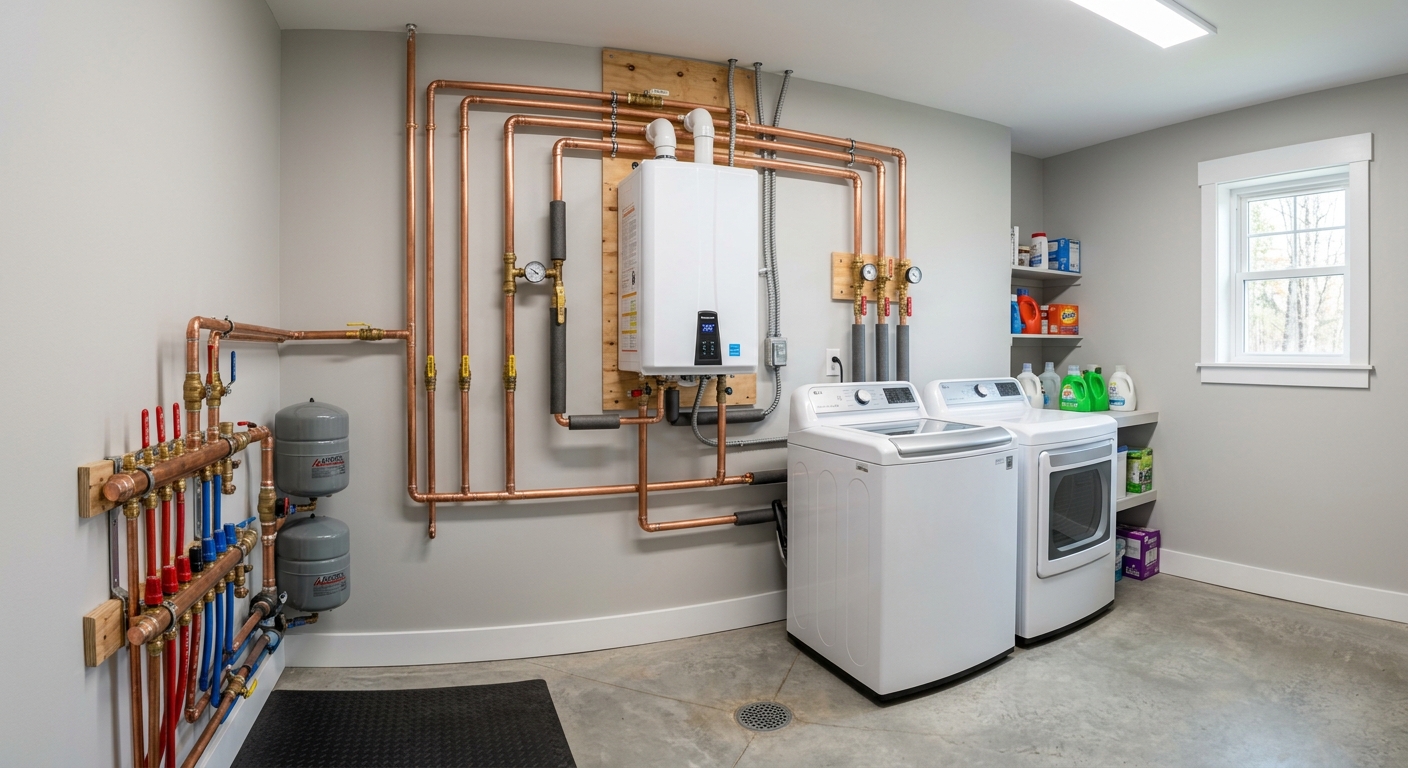
Plumbing services and costs in Lincoln
In Lincoln, Ontario, plumbing costs tend to move with two things homeowners feel every winter: freeze–thaw conditions and an older housing base. With 41.2% of homes built before 1981 (Statistics Canada, 2021 Census), it’s common to see legacy plumbing materials and layouts that make repairs more time-consuming—especially when supply lines, valves, or drain runs are hard to access. Homeowners also represent a large share of households (8,055 owner households, 84.3% ownership), which means more long-term upgrades like water-heater changeouts and full repipes rather than short-lived fixes.
In the Hamilton–Niagara Peninsula freeze–thaw zone, exterior supply lines and shallow basement plumbing need proper protection and burial depth. When cold snaps hit, burst-pipe calls often come from poorly insulated lines to garages, crawlspaces, and exterior hose bibs. On top of that, local water is typically moderately hard to hard, which accelerates scale buildup in tank-style water heaters and shortens anode and tank life. That’s why Lincoln homeowners in older neighbourhoods—particularly around St. Catharines Street and the established residential pockets near the Lincoln/South Lincoln area—often book earlier heater service or replacement.
To help you compare quotes, the table below summarizes typical service scopes and realistic price bands for Lincoln projects. If you’re planning a repair this week versus a longer upgrade before winter, you’ll see the cost differences clearly.
| Service |
What's Included |
Typical Duration |
Price Range |
| Emergency repair (burst pipe, active leak) |
Shutoff, isolate leak, repair/replace small section, pressure test, cleanup and basic restoration |
2–6 hours (same day when possible) |
$200–$850 |
| Water heater replacement (tank, 40–60 gallon) |
Haul-away, disconnect/reconnect, new venting checks (as required), start-up and test, basic commissioning |
4–8 hours |
$1,500–$3,200 |
| Tankless water heater installation |
New unit install, venting/air requirements checks, plumbing connections, commissioning and hot-water verification |
1 day (often 6–10 hours) |
$2,500–$5,800 |
| Full-home repipe (supply lines, PEX) |
Plan and layout, replace supply piping, valve upgrades as needed, pressure testing and flush-out |
2–5 days (varies by home size and access) |
$6,000–$12,000 |
| Drain snaking / hydro-jetting (blocked drain) |
Camera/diagnosis when needed, clear obstruction, test flow, minor cleanout access as required |
1–4 hours |
$200–$1,200 |
| Backwater valve installation |
Assessment, valve install on appropriate building drain location, seal/connection work, testing |
4–8 hours |
$1,400–$3,500 |
Prices are estimates only and vary by project scope, site access and material selection.
What affects the price of plumbing in Lincoln
Even when two homeowners describe the “same” problem, quotes across the Hamilton–Niagara Peninsula and the broader Ontario market can vary by 30–50%. That’s usually not because the plumber is padding the bill—it’s because the job scope changes once the crew opens walls, tests pressure, inspects vents, or discovers what’s actually blocking a line. Labour time (how hard the access is), whether you’re doing a repair versus replacement, and whether permits/inspections are required can all swing total cost.
Freeze risk sets real requirements for installation depth and protection. In Lincoln’s freeze–thaw zone, supply lines that would run to garages, crawlspaces, or outdoor taps must be insulated or protected and buried below typical local frost depth. If a line is shallow, plumbers often have to re-route or rework sections rather than “just fix the leak,” pushing the job toward the higher end of the repair band (for example, $200–$850 for a straightforward emergency repair can become a larger repair if you’re digging, insulating, or changing more pipe than expected).
Water hardness also drives costs. Moderately hard to hard water commonly accelerates scale in tank-style heaters and shortens tank life, which means more heater replacements and more frequent descaling work than in softer-water regions. On the fixture side, mineral deposits can shorten valve service life and contribute to stuck cartridges. For older homes from the 1980s into the mid-1990s, galvanized steel and some legacy poly-B piping may already be restricting flow or showing fitting failures—so a “repair” can evolve into repiping, and that’s where repipe pricing often reflects higher material and labour time, typically aligned with the regional repiping band of $2,500–$12,000.
In Lincoln specifically, two examples I see often: (1) a basement leak near a wall can require drywall removal and careful reassembly, adding hours; (2) a water-heater replacement in a hard-water home may justify a higher-grade anode or descaling plan because the next issue may be mineral build-up, not installation quality. That’s why pricing ties closely to site conditions and inspection findings.
| Price Factor |
Why It Matters |
Cost Impact |
| Type of work — repair vs. replacement vs. new install |
Repairs are usually localized; replacements/new installs require more labour, parts, and testing |
Repair jobs often cluster near $200–$850, while replacements/installations can move to higher bands |
| Water heater size and fuel type (gas vs. electric vs. tankless) |
Gas venting/air requirements and electrical demands affect labour and materials |
Tank installs often align with $1,500–$3,200; tankless can be substantially higher |
| Pipe material — PEX vs. copper vs. CPVC for repiping |
Material cost and labour steps differ; some systems require different fittings/approvals |
May shift repipe estimates by thousands depending on material selection and complexity |
| Access — pipes in walls or slab require drywall or concrete cutting |
Hidden pipes add demolition, patching, and risk of discovering additional damage |
Access challenges can move a job toward the upper end of the repipe/drain bands |
| Permit requirement — adds cost and inspection scheduling time |
Some work must be permitted and inspected, which affects scheduling and documentation |
Often adds both fees and calendar time; can noticeably affect total project cost |
| Emergency vs. scheduled — after-hours calls carry a premium |
After-hours labour, priority dispatch, and urgency-driven parts sourcing increase cost |
Emergency callouts commonly land near the high end of repair pricing |
| Water hardness — affects water heater sizing and descaling needs |
Hard water accelerates scale and can shorten heater life without periodic maintenance |
Can justify earlier replacement or add descaling/maintenance steps |
| Number of fixtures or drain lines involved |
More endpoints mean more testing, more access points, and more clearance steps |
Single-line issues are cheaper than multi-line problems, even with the same root cause |
Permits & regulations in Ontario
In Ontario, most plumbing work beyond simple fixture replacement must be done by a licensed plumber. While exact municipal practices can vary, permits are commonly required for the work that changes the plumbing system’s connection to the home’s drainage or water supply—especially when the job involves municipal water/sewer tie-ins, new drain connections, major changes to venting, or a full repipe. In many cases, water-heater changeouts can also require a permit depending on the type of heater, whether venting/vent routes change, and the local inspection approach.
Backwater valve installation is another area where homeowners should expect permit/inspection requirements more often than not, particularly because the valve must be installed at the correct building drain location and sealed properly to work reliably during surges.
To protect yourself in Lincoln, verify the contractor holds a valid Ontario journeyman or master plumber licence (and provides the licence details on the quote or invoice). Then request proof of liability insurance and WSIB/WCB coverage before work starts. Step-by-step:
- Ask for the plumber’s licence number and confirm it using the appropriate online Ontario licensing resources.
- Request a current certificate of insurance (liability) showing your address listed as the location of work.
- Request WSIB/WCB clearance documents or confirmation of coverage and document it in writing.
- Ensure the quote lists whether a permit will be pulled, who pulls it, and what inspections are expected.
- Get everything in writing before the first day of work so changes don’t become disputes later.
Common plumbing problems in Lincoln homes and how to fix them
Lincoln homeowners most often run into problems that match our freeze–thaw climate and older housing materials. Here are the five issues I see most, with practical ways to address them before they escalate.
(1) Burst or frozen pipes: In this region, exterior and lightly insulated basement lines (especially near garages, crawlspaces, and exterior hose bibs) can freeze, then burst when the cycle swings back. Prevention means insulation on exposed runs, heat trace where appropriate, and keeping cabinet doors open during extreme cold. If it happens, emergency response is about shutting off water, draining the affected section safely, then repairing damaged pipe and verifying pressure before restoring service.
(2) Aging pipe materials: Galvanized steel can corrode and restrict flow over time, and poly-B (seen in homes from the 1980s through mid-1990s) can develop brittle failure at fittings. When the system starts showing repeated leaks, proactive repiping is often cheaper than repeated repairs—especially because one “small” repair can crack adjacent connections once the fittings are disturbed. A repipe is usually priced in the multi-thousand range (often within the $2,500–$12,000 band depending on access and home size).
(3) Water heater end-of-life: Tank heaters take the harder hit in hard-water areas due to scale buildup, and you’ll see shorter service intervals than in softer-water regions. Tankless can be a better long-term investment when sized correctly for flow demands, but it still must be maintained in hard-water conditions.
(4) Low water pressure: Common causes include clogged aerators, scale/discolouration from galvanized lines, or pressure drop. Plumbers diagnose by checking pressure at fixtures and testing upstream shutoffs, then chasing the cause line-by-line rather than replacing parts blindly.
(5) Drain issues: Slow drains can be mineral build-up, partial blockage, or root intrusion—particularly on older drain lines in established Lincoln neighbourhoods. Hydro-jetting or camera inspection helps separate “simple blockage” from “failed drain run,” which is where repair options change drastically.
For example, a minor blockage might be resolved with drain snaking/jetting in the repair tier, while ignoring repeated backups on an older cast-iron run can lead to a full drain replacement costing far more. The goal is to diagnose early so you pick the option that matches the real root cause—not just the symptom.
| Issue |
Common Cause in Lincoln |
Typical Fix |
Price Band |
| Burst or frozen pipe |
Freeze–thaw stress on exterior lines, garage/crawlspace plumbing, or poorly insulated basement runs |
Shutoff, isolate section, repair/replace damaged pipe, insulate and test pressure |
$200–$850 |
| Low water pressure throughout home |
Corroded galvanized supply lines, partially closed shutoff, or municipal/system pressure drop |
Diagnose supply pressure, clean/replace aerators/valves, flush supply lines, repair sections as needed |
$180–$900 |
| Slow or blocked drain |
Partial blockage, mineral build-up, or early root intrusion in older drain lines |
Camera inspection, snaking or hydro-jetting, confirm full flow and clear mainline |
$200–$1,200 |
| Leaking or failed water heater |
Tank wear accelerated by hard water scale and anode consumption, failing valves or age-related corrosion |
Replace tank unit, verify venting/controls, flush and test; recommend descaling plan |
$1,500–$3,200 |
| Poly-B pipe failure (fitting or pipe crack) |
Brittle failures and cracking at fittings or sections over time (common in some late-20th-century builds) |
Localized repair for pinpointed failures or full repipe if multiple leak points exist |
$2,500–$12,000 |
| Galvanized pipe corrosion (restricted flow, discolouration) |
Internal corrosion reducing flow and causing sediment/discolouration in hot or cold lines |
Replace corroded sections; if widespread, consider full-home repipe to PEX or copper systems |
$2,500–$12,000 |
How to choose a plumbing contractor in Lincoln
Choosing the right plumber in Lincoln starts with verifying credentials and protecting yourself on paperwork. In Ontario, you should confirm the contractor’s Ontario journeyman or master plumber licence (ask for the licence number and proof they’re the licensed individual performing/supervising the work). Next, request a current certificate of liability insurance—your quote should not proceed until you’ve seen the document. Also confirm WSIB/WCB coverage (or appropriate clearance) so you’re not left exposed if someone is injured on your property.
Then get 2–3 itemised written quotes. “Itemised” matters: look for a breakdown showing labour, parts, disposal/haul-away, and any diagnostics (like camera inspection). Ask whether the permit will be pulled and whether inspection scheduling is included. Read exclusions carefully—common ones are drywall restoration, concrete cutting/patching, new shutoffs/valves, and additional labour if the plumber discovers code or material issues behind walls. For warranty, ask for two things: the workmanship warranty length and the product/manufacturer warranty. Confirm whether warranties are transferable to future owners.
Payment schedule is another control point. Never pay more than 10–15% upfront for typical residential work, and request a holdback until completion and testing are done. Finally, get the start date and completion estimate in writing, including when parts are expected. In our freeze–thaw region, scheduling matters because waiting too long on a leak can mean more hidden damage by the next cold snap.
- Verify Ontario licence number and match it to the quote/invoice.
- Request liability insurance certificate and confirm coverage for your address.
- Confirm WSIB/WCB clearance before work starts.
- Ask for itemised labour + materials (no lump-sum only quotes).
- Confirm whether diagnostics (pressure tests, camera inspection) are included.
- Ask who pulls the permit and whether permit/inspection fees are included.
- Confirm disposal/haul-away is included for old heater/parts.
- Clarify restoration scope (drywall patching, minor carpentry, sealing).
- Check warranty terms in writing (workmanship and manufacturer).
- Agree on a payment schedule: 10–15% max upfront; holdback after testing.
- Get start date, realistic timeline, and an escalation plan for delays.
- Require clean, written change-order pricing if scope expands after inspection.
Red flags in Lincoln: a contractor who won’t provide licence/insurance/WSIB proof; quotes that aren’t itemised (or refuse to show a permit plan); promises of “universal” pricing without visiting the site; pressure to pay the full amount upfront; or vague warranties with no duration or scope specified.
Frequently asked questions — plumbing in Lincoln
What is a sump pump and do I need one in Lincoln?
A sump pump collects water from a sump basin (usually in a basement) and pumps it away from the foundation, helping manage water intrusion and sometimes reducing risk during heavy rain or drainage surges. In Lincoln and the wider Hamilton–Niagara Peninsula, you may see more basement moisture complaints because of the freeze–thaw cycle—water can move in and around foundations, then freeze and expand. You don’t “automatically” need a sump pump, but it’s worth evaluating if you have recurring seepage, a wet basement floor after storms, or a history of water pooling near foundation walls. A plumber can assess your drainage pattern, check grading/weep areas, and discuss whether you also need a backwater valve for sewer backup scenarios.
How much does a plumber cost in Lincoln?
In Lincoln, plumber pricing commonly follows repair/service tiers plus labour time. For many straightforward emergencies like fixing an active leak, many homeowners land in the repair band of $200–$850, especially if the issue is accessible and parts are readily available. For more involved work—like diagnosis plus multiple valve changes or small pipe sections—the total can rise depending on access and what’s discovered once the wall or shutoffs are exposed. Labour rates across the region are often roughly $80–$170 per hour for licensed plumbers (depending on urgency and trade complexity), and after-hours calls typically cost more. For an accurate number, request an itemised quote and ask what’s included in the diagnostic portion.
How much does water heater installation cost in Lincoln?
For a standard tank water heater installation in Lincoln, many projects fall around $1,500–$3,200. The final price depends on the heater size, whether it’s gas or electric, venting requirements, and what condition the existing plumbing/valves are in. Hard water in the Hamilton–Niagara Peninsula can reduce tank life faster due to scale buildup, so some homeowners choose higher-quality components and a maintenance plan at install time. If your installation requires more than a straightforward swap—like relocating the unit, upgrading venting, or addressing corroded connections—cost can move toward the upper portion of the band. The most reliable approach is a site visit and a quote that breaks down labour, unit cost, venting/materials, and disposal.
Tank vs tankless water heater — which is better?
Tank and tankless both work well, but “better” depends on your hot-water demand, energy/fuel setup, and maintenance tolerance—especially with the moderately hard to hard water common around Lincoln. A tank heater is usually simpler and often cheaper to install, and typical installation pricing in Lincoln lands around $1,500–$3,200 for many standard replacements. Tankless units provide continuous hot water and can improve efficiency in homes with steady usage, but they require correct sizing and periodic maintenance to handle scale. In hard-water areas, ignoring maintenance can shorten performance and increase descaling needs. If you have larger families, higher simultaneous hot-water use, or frequent hard-water scaling issues, a properly sized tankless or a well-spec’d tank with maintenance may be the better long-term choice—your plumber should calculate flow demand and recommend based on your exact fixtures and water conditions.
How do I prevent frozen pipes in Lincoln?
Preventing frozen pipes in Lincoln is mainly about insulation and keeping water moving where it’s at risk. Focus on exterior lines and any plumbing near unheated spaces: garages, crawlspaces, and basements with exposed runs. Insulate pipes using proper foam sleeves and seal gaps around the pipe where it enters the home. For exterior hose bibs, disconnect hoses and consider heat trace where insulation isn’t practical. In extreme cold snaps, keep cabinet doors open on affected vanity areas and allow a small drip from the highest-risk fixture if you’ve had freeze issues before. If you’ve had bursts before, ask your plumber to assess burial depth, line routing, and whether rerouting or adding insulation/heating protection would be cost-effective.
Why is my water pressure low?
Low water pressure in Lincoln often comes from either fixture restriction or supply-line issues. Start with the easiest checks: clean clogged aerators and showerheads, ensure shutoffs are fully open, and test whether pressure is low only on hot or only on cold. If it’s throughout the home, a plumber may test pressure at the main shutoff and then investigate upstream supply components. In homes built in earlier eras—where galvanized steel may be present—corrosion and sediment can restrict flow over time, causing both pressure drops and discolouration. Municipal pressure variations can also contribute, especially when demand is high. A licensed plumber can diagnose by isolating sections of the system, and if the cause is widespread restriction, you may need more than a simple aerator cleaning.