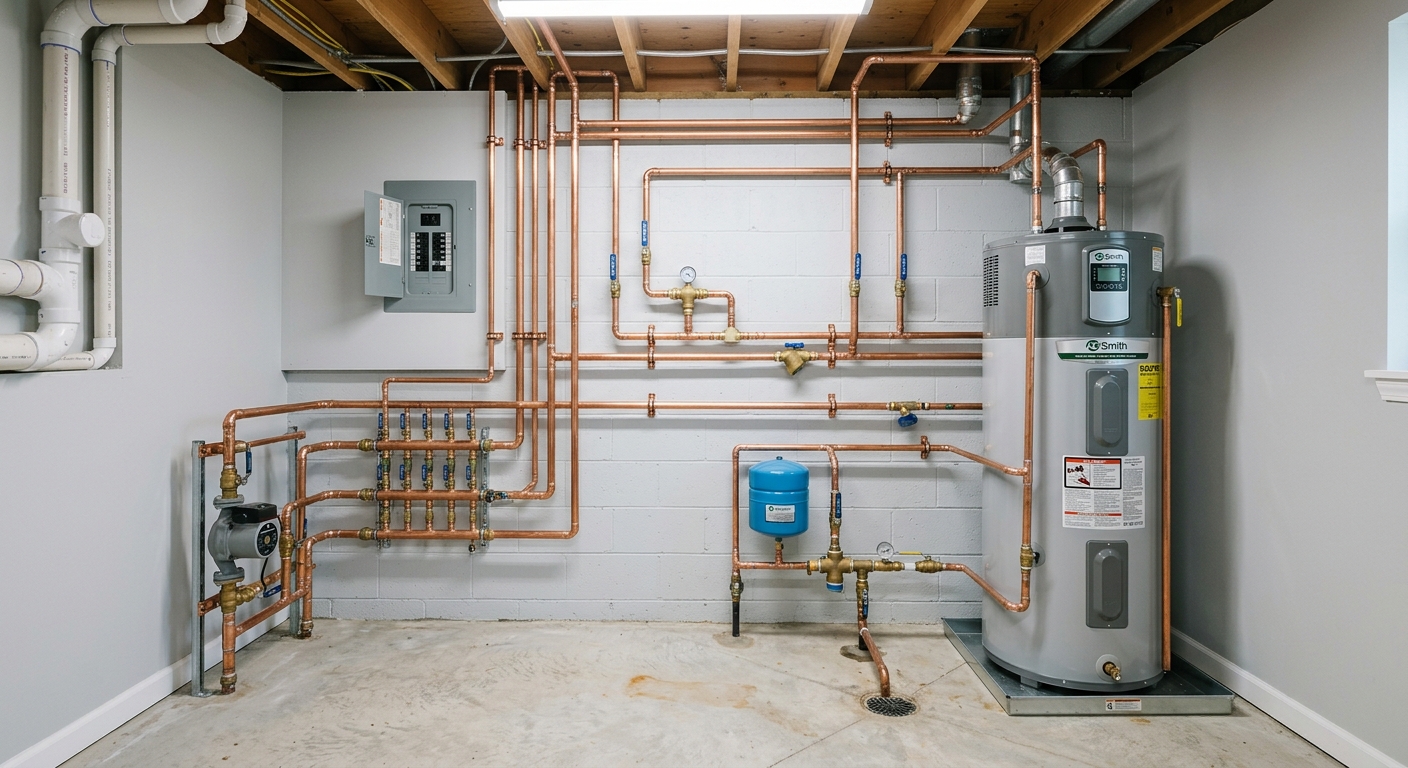
Plumbing services and costs in Stratford
Plumbing in Stratford, Ontario comes with a distinct mix of older housing and winter freeze risk, which is why costs can move quickly once a problem starts. In Stratford’s homeowner-heavy neighbourhoods (9,705 homeowner households, 65.8% of all households), many properties are in the higher-maintenance bracket—64.5% of homes were built before 1981, so it’s not unusual to find galvanized steel supply lines, legacy lead service lines, or cast-iron drains hidden behind finishes. When those systems age, small leaks turn into bigger access jobs, and supply restrictions can also shorten water-heater life.
Stratford–Bruce Peninsula winters are consistently cold, and freeze risk is a major cost driver: exterior or garage supply lines must be set below frost depth, and any shallow runs or poorly insulated areas can lead to winter burst-pipe and frozen-line calls. On top of that, the region’s moderately to very hard municipal and well water accelerates mineral scale on tanks, shower valves, and faucets—so service and replacements are often more frequent than in softer-water areas.
Contractor availability also matters. High-volume periods around the coldest weeks mean emergency call-outs cost more, and labour travel across the spread-out rural coverage area (including Stratford’s west side near Shakespeare Road and the Stratford industrial belt off Highway 7/8) can add to total invoices.
Below is a practical cost comparison you can use when you’re preparing to get quotes—then we’ll break down exactly what changes the price.
| Service |
What's Included |
Typical Duration |
Price Range |
| Emergency repair (burst pipe, active leak) |
Site assessment, leak isolation, shutoff verification, repair or pipe section replacement, pressure test, cleanup |
2–6 hours (sometimes longer with access) |
$200–$900 |
| Water heater replacement (tank, 40–60 gallon) |
Remove/haul-away old unit, install new tank, connect supply/venting, leak pan and discharge line setup (as applicable), start-up and testing |
4–8 hours |
$1,400–$3,200 |
| Tankless water heater installation |
Site review, gas/electrical verification, mounting and venting configuration, plumbing connections, commissioning and flow testing |
1–2 days |
$2,500–$5,500 |
| Full-home repipe (supply lines, PEX) |
Water shutoff plan, removal of old piping, new PEX install, fixture tie-ins, pressure test, flushing and final inspection-ready check |
2–6 days (often more with access) |
$4,000–$15,000 |
| Drain snaking / hydro-jetting (blocked drain) |
Camera check if needed, mechanical snake and/or hydro-jet, clearing trap and branch lines, post-clearance flow test |
1–4 hours |
$250–$1,200 |
| Backwater valve installation |
Mark-out and confirm drain route, install backwater valve at correct location, sealing, testing, and inspection preparation |
4–8 hours |
$1,500–$3,500 |
Prices are estimates only and vary by project scope, site access and material selection.
What affects the price of plumbing in Stratford
Even when the problem sounds identical, plumbing quotes in Stratford–Bruce Peninsula can differ by roughly 30–50% once you factor in freeze risk, pipe age, and how much access the job requires. In Ontario generally, labour rates and after-hours premiums apply everywhere, but Stratford’s cold-season call volume raises the likelihood that contractors price in emergency demand and additional planning time for nighttime call-outs.
Freeze risk sets how deep supply lines must be buried, and it also influences whether exterior or garage lines need extra insulation or heat trace. A “minor” leak on an exterior run can become an access-heavy job if the line is shallow or has repeated freeze-thaw damage. Water hardness is another sharp driver: mineral-heavy water shortens water-heater life and increases scale on fixtures, so a replacement might be the more economical long-term move. In practical terms, a tank replacement in the $1,400–$3,200 band can be a better value than repeated flushes or descaling when scale buildup has already reduced efficiency.
Housing stock age matters, too. Homes from the 1980s to mid-1990s across the region may include older copper systems with aging joints, and some properties have poly-B piping that’s known for fitting and connection failures. Galvanized steel is also still commonly encountered in Stratford—corrosion and mineral restriction can reduce flow over time, pushing homeowners toward a higher-ticket repipe in the $4,000–$15,000 range when multiple fixtures and runs are affected.
Here are concrete cost examples: (1) a blocked main line that requires camera evaluation and deeper access will price higher than a simple trap-clear; (2) a weekend emergency leak under a finished ceiling typically costs substantially more than a scheduled repair in a basement access area; and (3) replacing a heater with undersized shutoffs or hard-water scale-damaged fittings can raise parts and labour time.
| Price Factor |
Why It Matters |
Cost Impact |
| Type of work — repair vs. replacement vs. new install |
Replacement and new installs require more labour steps, parts, and testing than a simple repair |
Repairs often sit around the $200–$900 range; full replacements and installs can jump to the $1,400–$15,000 bands |
| Water heater size and fuel type (gas vs. electric vs. tankless) |
Vent/combustion requirements and electrical upgrades can add labour and materials |
Tankless can require higher total cost than standard tank swaps; tank size affects labour and parts |
| Pipe material — PEX vs. copper vs. CPVC for repiping |
Material cost and labour complexity vary; existing pipe compatibility affects connection work |
PEX repipes often price competitively; copper/CPVC can raise material and time costs |
| Access — pipes in walls or slab require drywall or concrete cutting |
More demolition and reinstatement = more time and disposal |
Access can be the difference between a repair-only outcome and a full repipe cost increase |
| Permit requirement — adds cost and inspection scheduling time |
Permits/inspections can delay work and add administrative steps |
Typically modest fees but can extend the schedule; delays add overhead in winter |
| Emergency vs. scheduled — after-hours calls carry a premium |
Rapid attendance, risk controls, and priority scheduling raise the labour cost |
Emergency calls can push jobs toward the upper end of the repair bands |
| Water hardness — affects water heater sizing and descaling needs |
Scale buildup reduces efficiency and accelerates component wear |
Can shorten replacement intervals and increase servicing frequency; improves ROI for correctly sized heaters |
| Number of fixtures or drain lines involved |
Multiple affected lines mean longer tracing, more testing, and potentially more pipe work |
Single-fixture issues are cheaper; whole-branch or multi-trap problems raise total cost |
Permits & regulations in Ontario
In Ontario, most plumbing work beyond simple fixture replacement must be performed by a licensed plumber. Work that typically requires a permit includes new connections or modifications that involve the municipal water or sewer system, full repiping, any new drain connection, and many water-heater changeouts depending on local requirements and how the unit is vented/connected. Backwater valve installation—often recommended in Stratford’s flood-and-snow-melt conditions where yard grading and spring runoff can surcharge drains—usually requires a permit and inspection.
Before work starts, Stratford homeowners should verify the plumber is properly licensed and insured. Step-by-step: (1) ask for the Ontario licence details and confirm it using the Ontario online registry for journeyman/master plumbers; (2) request proof of liability insurance showing the plumber’s business name and coverage amount; (3) request WSIB/WCB coverage documentation—this matters if any tradespeople are on site; and (4) get a clearance letter/insurance certificate updated for the project dates when applicable.
What typically does not require a permit is minor like-for-like fixture swaps (for example, replacing a faucet or toilet with no changes to existing plumbing rough-ins), but you still want it done to code and with proper shutoff and sealing. If the scope includes changing pipe routes, adding shutoffs, modifying vents, or touching drains connected to the sewer, treat it as permit-worthy and ask the contractor to confirm in writing.
Common plumbing problems in Stratford homes and how to fix them
In Stratford, the five most common plumbing issues I see are shaped by winter freeze risk, older pipe materials, and hard water buildup. (1) Burst or frozen pipes: the usual culprit is an exterior, garage, or poorly insulated run that drops near or below frost protection in a cold snap. Prevention is insulation plus heat trace where appropriate, and sealing drafts around service entry points. If a pipe bursts, the priority is shutting off water, draining safely if needed, and calling for repair quickly to prevent ceiling/floor damage.
(2) Aging pipe materials: galvanized steel can corrode internally, reducing flow and staining fixtures; poly-B fittings can fail, sometimes cracking where fittings or tees were joined. Both warrant proactive planning. Waiting for “one more season” can turn a manageable repair into a larger wall/ceiling access job.
(3) Water heater end-of-life: in moderately to very hard water conditions, scale affects both tanks and heat exchangers. If you have heavy scaling and frequent temperature swings, a standard tank replacement in the $1,400–$3,200 range may be the most practical first step. Tankless can be efficient, but it’s also more sensitive to flow and scale—so if you’re already dealing with mineral buildup, correct sizing and maintenance matter.
(4) Low water pressure throughout the home: plumbers typically check aerators first, then trace whether it’s a whole-house restriction—often from corroded galvanized lines or a supply pressure issue. (5) Drain issues: slow drains can be root intrusion, mineral buildup, or failed older cast-iron sections. A camera inspection is usually the fastest way to avoid repeated “snake and hope” attempts.
Dollar example: a single blocked kitchen line might look like a quick snaking job, but if camera review shows a cast-iron section deteriorating, you could be choosing between a cheaper $250–$1,200 clearing and a higher drain replacement path. Paying for the right diagnostic early often prevents paying twice.
| Issue |
Common Cause in Stratford |
Typical Fix |
Price Band |
| Burst or frozen pipe |
Frozen exterior/garage supply lines, shallow insulation gaps, winter freeze-thaw on older runs |
Isolate leak, replace damaged section, re-insulate/heat-trace as required, pressure test |
$200–$900 |
| Low water pressure throughout home |
Corroded galvanized supply lines, partially blocked shutoffs, mineral restriction in older plumbing |
Check aerators/shutoffs, measure pressure, scope supplies, repair/replace restricted piping |
$250–$2,500 |
| Slow or blocked drain |
Tree root intrusion into older drain lines, grease buildup, partial collapse in aged cast iron |
Camera inspection, snaking or hydro-jetting, repair affected section if needed |
$250–$1,200 |
| Leaking or failed water heater |
Tank corrosion from hard water scale, worn fittings, aged venting connections |
Replace unit, connect/disconnect safely, set discharge and confirm operation and venting |
$1,400–$3,200 |
| Poly-B pipe failure (fitting or pipe crack) |
Fitting/connective failures and brittle degradation in certain older installs |
Identify affected zones, cut and replace sections with approved materials, pressure test |
$4,000–$15,000 |
| Galvanized pipe corrosion (restricted flow, discolouration) |
Internal rust scaling and reduced flow from aged supply lines common in older Stratford homes |
Repair isolated runs or plan full repipe, replace corroded sections, confirm flow and pressure |
$4,000–$15,000 |
How to choose a plumbing contractor in Stratford
Choosing the right plumber in Stratford starts with verifying Ontario licensing, insurance, and work coverage. Ask for the licence number and company details, then confirm the individual’s Ontario journeyman/master status using the Ontario online registry. Next, request a certificate of liability insurance (or proof of coverage) showing the business name and effective dates for your job. For coverage of employees, request WSIB/WCB clearance or proof—especially if the contractor subcontracts labour or brings in helpers. If they can’t provide these documents promptly, move on.
For pricing, get 2–3 itemised written quotes. You want a breakdown of labour hours, parts/materials, and any diagnostic fees separately—rather than a single lump sum. Review the scope line-by-line: confirm whether permit fees and permit pulling are included, whether excavation/demolition is included if pipes are behind walls or slab, and whether disposal/hauling is included. For warranties, ask for both workmanship warranty length and the manufacturer warranty on the equipment; also ask if the warranty transfers to you as the homeowner. Payment should stay controlled: never pay more than 10–15% upfront, and hold back a portion until you’re satisfied with testing and completion. Finally, insist on a written start date and an estimated completion timeline.
- Licence number on the estimate, matched to the Ontario online registry
- Proof of liability insurance with active dates and your contractor named
- WSIB/WCB coverage or clearance documentation provided before scheduling
- Itemised quote: labour, parts, valves/fittings, disposal, and diagnostics listed separately
- Scope clarity: what’s included vs excluded (camera, hydro-jet, pressure test, drywall restoration)
- Permit confirmation: who pulls it, expected inspection timing, and whether it’s included
- Backwater valve positioning and required discharge/tie-in details described in writing
- Pipe material plan documented (PEX brand/spec where relevant) and connection method
- Written warranty terms for workmanship and manufacturer equipment
- Payment schedule in writing with a small deposit and holdback until testing passes
- Cold-weather contingency plan (freeze protection measures during the work)
- Start and completion estimate with a realistic buffer for access and curing times
Red flags I’d watch for in Stratford include: (1) refusal to provide licence/insurance documentation; (2) quoting only by phone without an on-site assessment for anything involving drains, repiping, or water heaters; (3) vague scopes like “fix the leak” without describing access, testing, and restoration; (4) insisting on large upfront deposits (over 10–15%); and (5) no written warranty details or no clear plan for permits when the work touches municipal water/sewer connections.
Frequently asked questions — plumbing in Stratford
Can I claim a plumbing repair on home insurance in Ontario?
Sometimes, but it depends on the cause and what your Stratford or Ontario policy covers. Insurance commonly covers sudden and accidental water damage—for example, a burst supply line due to a freeze event—if you had normal maintenance and the damage wasn’t from long-term neglect. Repairs themselves may be covered when they stop active water damage, but cosmetic restoration and maintenance-related failures can be limited. Start by checking your policy’s “sudden” wording and exclusions, then contact your insurer promptly with photos, dates, and the plumber’s invoice showing the cause (frozen vs. corrosion, for instance). If your plumber documents freeze exposure or a failed component, it helps your claim. If it’s a slow leak from aging galvanized pipe, you may face more questions about how long it went unnoticed. Typical repairs still often fall in the $200–$900 range for emergency-type stops, but insurance decisions depend more on cause than on the exact cost.
How do I prevent drain clogs in my Stratford home?
Start with the high-frequency habits: avoid pouring grease, coffee grounds, and “flushable” wipes down drains. Use strainers in kitchen and bathroom sinks, and periodically run hot water after heavy use—hard-water scale and soap residue can contribute to buildup over time. For preventive maintenance in Stratford’s colder months, keep an eye on vents and air admittance lines; blocked venting can worsen slow drains. If you have older cast-iron or galvanized-adjacent drainage, consider an annual inspection approach instead of waiting for total blockage. When you do get symptoms—slow drainage, gurgling, or repeated backups—ask for a camera inspection before repeated snaking. A good diagnosis can prevent paying for multiple cleanings when there’s root intrusion. For reference, a simple snaking or hydro-jet clear often lands around the $250–$1,200 band, while root-related or section failures can require more involved repair.
What is the difference between ABS and PVC pipe?
ABS (black) and PVC (white/grey) are both common plastic drain/waste pipe materials, but they’re used differently depending on the system and local spec. ABS is typically used for certain drain/waste/vent applications because it has good impact resistance, while PVC is widely used for drain and vent piping in many Canadian homes because it’s chemically resistant and durable. The real homeowner-facing differences are usually: how the joints are made (solvent cement types can differ), how the pipe behaves with heat, and what’s required to match existing plumbing in older Stratford builds. If you’re repairing a section, the key is compatibility—mixing materials incorrectly or using the wrong primer/cement can create weak joints. A licensed plumber will identify what you have before swapping sections. If you’re doing something like a localized drain repair, costs vary heavily by access and whether the fix stays within the drain run (commonly less than a full repipe).
How do I know if I have a slab leak in Stratford?
Slab leaks are harder to detect because water travels through the concrete and can appear as “mystery” dampness. In Stratford’s older housing stock, pay attention to unexplained increases in water bills, persistent damp spots, warm areas on floors, or unusual mouldy odours near baseboards. Another common sign is water pressure fluctuations alongside constant consumption, especially when no fixtures are running. A plumber typically confirms slab leaks with a combination of leak detection: shutoff testing, meter checks, and then locating methods like acoustic/thermal tools (where appropriate). Once a leak is confirmed, the next step is deciding whether you can access safely or if partial/section cutting and repiping is required. Slab work can escalate costs due to concrete access and restoration, which is why early diagnosis matters. While a simple emergency fix can be in the $200–$900 range, slab repairs are usually far beyond that because access drives labour.
What is a sump pump and do I need one in Stratford?
A sump pump collects groundwater from a sump basin (often in a basement or low crawl space) and pumps it away to reduce flooding risk. In Stratford, whether you “need” one depends on your lot drainage, basement water history, groundwater levels, and whether downspouts and grading keep water away from the foundation. Some homes mainly benefit from improved drainage and a backwater valve, while others—especially those with recurring spring runoff or a naturally high water table—often do better with a sump system. If you’re getting sewage odours or backups, a backwater valve may be the more urgent protection for sewer surcharges; it can be a separate installation that typically requires a permit and inspection. For homeowners with freeze cycles, ensure any sump components are properly installed to avoid issues during power outages and that discharge routing won’t freeze at the discharge point.
How much does a plumber cost in Stratford?
Stratford plumber pricing is usually driven by time, access, and whether it’s emergency work. Many standard repairs land in the $200–$900 band when the fix is straightforward and accessible. Water heater replacement (tank, 40–60 gallon) commonly falls in the $1,400–$3,200 range, while full-home repiping and extensive drain work are higher-ticket projects that can reach $4,000–$15,000 depending on scope and what must be opened up. Labour is commonly billed around 90–170/hour for regular work, with emergencies priced higher due to after-hours attendance and winter risk management. In cold months, freeze-related calls can cost more because of urgency and the extra steps needed to prevent repeat damage. The best way to budget accurately is an itemised quote that breaks down labour hours, parts, diagnostics, and any permit work—so you can see what’s included rather than relying on a single number.