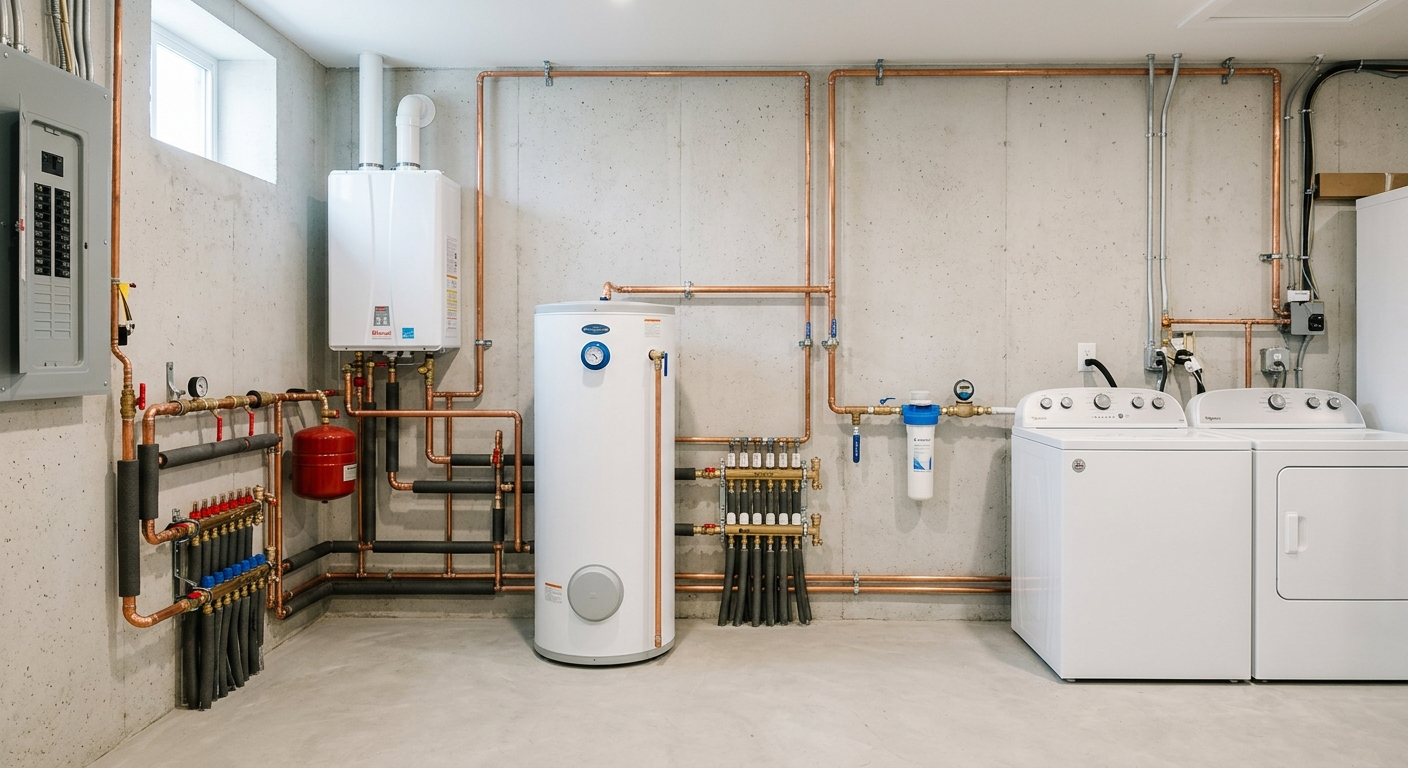
Plumbing services and costs in Evanston
Evanston, Alberta is a young community on the Calgary-area market, and that matters for plumbing pricing—newer builds can be straightforward installs, while older houses (and the homes surrounding Evanston that date back to earlier eras of development) often bring legacy piping and more frequent service work. In 2021, Evanston had a population of 18,710 (Statistics Canada, 2021 Census), and that growing customer base is exactly why emergency calls and winter maintenance appointments tend to book quickly when cold snaps hit. Across the Calgary region, contractors also see a higher share of end-of-life plumbing components in established neighbourhoods, which is why you’ll frequently find water-heater replacements and “partial-to-full” repipe scenarios in the same week.
Local climate is the biggest cost driver. Calgary-area freeze risk can turn a small plumbing issue into a burst-pipe emergency when exterior-wall and unheated areas are under-insulated. In practice, that means plumbers spend more time protecting supply lines at the foundation and servicing entry points, not just swapping parts. Another reason estimates vary is access and restoration: opening ceilings, walls, or flooring to reach older supply routes often costs more than the pipe labour itself.
Within Evanston, trades are often especially in demand along the newer residential edges where homes are close to exposed exterior runs and garage/service-entry lines—those are the spots that get overlooked until a freeze event forces an urgent visit. With that in mind, the table below compares common service types you’ll see from Calgary-region plumbers, with typical duration and realistic price ranges.
| Service |
What's Included |
Typical Duration |
Price Range |
| Emergency repair (burst pipe, active leak) |
Locate leak, shutoff/isolate, repair/replace damaged section, basic pressure test, restore minor access; includes after-hours call-out where applicable |
2–6 hours (sometimes same day, more if floors/walls require opening) |
$180–$900 |
| Water heater replacement (tank, 40–60 gallon) |
Haul away old unit (where permitted), install new tank, connect to vent/drain/lines, leak test, flush brief system, basic start-up checks |
4–8 hours |
$1,800–$5,200 |
| Tankless water heater installation |
Site assessment, new unit install and connections, venting/condensate (as required), commissioning, hot-water performance test |
1 day (often 6–10 hours depending on venting and wiring needs) |
$3,000–$7,500 |
| Full-home repipe (supply lines, PEX) |
Abandon/replace supply piping throughout home, new shutoffs, tie-ins at fixtures, pressure test, flush, and allowance for restoration depending on access plan |
2–5 days |
$3,500–$18,000 |
| Drain snaking / hydro-jetting (blocked drain) |
Inspection and routing, snake jetting, clear blockage, flush line, camera check if needed; minor trap/fixture re-seating |
1–3 hours (longer if multiple cleanouts are needed) |
$180–$900 |
| Backwater valve installation |
Identify risk points, install backwater valve at appropriate location, reseal connections, test operation |
4–7 hours |
$1,200–$3,200 |
Prices are estimates only and vary by project scope, site access and material selection.
What affects the price of plumbing in Evanston
For the same plumbing problem, two Evanston homeowners can see quotes that differ by 30–50% across the Calgary and broader Alberta market. The spread usually isn’t “because plumbers are inconsistent”—it’s because freeze exposure, access constraints, pipe material, and restoration requirements vary from house to house. When winter freeze risk is high, contractors may need extra time to protect lines and locate insulation gaps before repair, and after-hours response can add a premium.
Freeze risk also determines how deep and how well supply lines are protected. In Calgary-region conditions, plumbers commonly deal with service entries that run through garage or exterior-wall areas where insulation is thin or drafts are present. If heat trace or proper insulation isn’t installed, those lines can freeze sooner, and frozen-pipe damage can escalate quickly—especially if a leak has been running and the slab or wall has already been affected. Water hardness is another meaningful variable: harder water accelerates mineral scale in water heaters and fixtures, which can shorten replacement intervals and increase descaling labour in some neighbourhoods.
Housing age drives pipe material problems. Across the Calgary region, older housing stock increases the likelihood of galvanized, corroded, or legacy lead service lines, and that often pushes jobs from a “repair” mindset into a “replace the lines before they fail” plan. In homes built or renovated in the 1980s through mid-1990s, poly-B piping failures can also be seen, often starting with fittings and then progressing. As a result, your quote may start near the repair range (for example, $180–$900 for some emergency fixes) but shift toward the repipe range ($3,500–$18,000) when the issue is wider than a single broken section.
In Evanston specifically, cost commonly rises when the supply runs are inside exterior wall cavities, when drywall and flooring restoration is required, or when the shutoffs are difficult to access. It can be lower when the problem is localized, shutoffs are reachable, and the plumber can reuse existing cleanouts or valve locations without extra demolition.
| Price Factor |
Why It Matters |
Cost Impact |
| Type of work — repair vs. replacement vs. new install |
Repairs are part-swaps; replacements and new installs add labour, testing, and sometimes new venting/pipe routing |
Often shifts estimates by 30–50% |
| Water heater size and fuel type (gas vs. electric vs. tankless) |
Capacity, venting requirements, electrical load, and vent/condensate routing change install complexity |
Can move the job from low to high end of the $1,800–$5,200 band |
| Pipe material — PEX vs. copper vs. CPVC for repiping |
Material cost, fitting compatibility, and corrosion/age of existing lines affect labour and tie-in time |
Moderate increase for premium materials or more complex tie-ins |
| Access — pipes in walls or slab require drywall or concrete cutting |
Opening and restoration are time-consuming and can add hidden scope if the run isn’t “accessible” |
Large swing; restoration can rival pipe labour |
| Permit requirement — adds cost and inspection scheduling time |
Permits/inspections introduce administrative time and sometimes scheduling delays |
Often adds a noticeable but predictable premium |
| Emergency vs. scheduled — after-hours calls carry a premium |
After-hours staffing and priority routing increase cost |
Typically adds cost on top of the base service |
| Water hardness — affects water heater sizing and descaling needs |
Scale buildup reduces efficiency and can raise service labour for flushing/descaling |
May shorten replacement intervals and add maintenance time |
| Number of fixtures or drain lines involved |
Multiple affected fixtures or shared vent/drain sections mean more isolation and testing |
Higher complexity and increased diagnostic time |
Permits & regulations in Alberta
In Alberta, most plumbing work beyond simple fixture replacement must be done by a licensed plumber. In practice, the work that typically requires a permit (and therefore usually an inspection) includes connecting to the municipal water or sewer system, new drain connections, full repiping, and many water-heater changeouts where the installation involves venting and code-required connections. Backwater valve installation is also commonly treated as permit/inspection work because it changes the way waste water is managed during storm events.
What usually does not require a permit (in many situations) is replacing like-for-like plumbing fixtures that don’t alter existing supply/drain connections—think swapping a kitchen faucet, toilet fill valve, or shower trim—provided no new lines are run and no municipal connections are modified. However, rules can vary based on what’s being changed, so ask the contractor to confirm permit requirements in writing before work starts.
To verify an Edmonton-area plumber for an Evanston job, follow a simple checklist: (1) confirm Alberta journeyman or master licence status via the provincial online registry (search their legal business/plumber name); (2) request a certificate of insurance showing liability coverage; (3) confirm WSIB/WCB coverage for worker protection; and (4) ask for a clearance letter if they’re registered and required to provide one. If they can’t provide these documents promptly, that’s a red flag—especially for time-sensitive winter repairs where you don’t want delays waiting for documentation.
Common plumbing problems in Evanston homes and how to fix them
In Evanston, Calgary-region freeze risk turns “small” plumbing problems into expensive ones quickly, especially when supply lines run through unheated or exterior-wall spaces. The most common issues homeowners report fall into five buckets—and the fix is usually about stopping damage early, not just swapping parts.
(1) Burst or frozen pipes: Prevention is insulation and sealing drafts around foundation penetrations and ensuring exterior/garage service entries aren’t left unprotected. When a pipe bursts, response matters—shut off water, open the affected area safely, and call for leak location and repair. Emergency work can land in the repair range of $180–$900 when the leak is isolated, but water damage from a missed leak can push the overall project far higher.
(2) Aging pipe materials: Galvanized steel can corrode and restrict flow; poly-B can fail at fittings or with brittleness over time. In older Calgary-area housing stock, it’s often cheaper long-term to plan proactive repiping rather than recurring repairs—especially once discolouration, repeated leaks, or pressure irregularities show up.
(3) Water heater end-of-life: Tank replacements typically fit the $1,800–$5,200 band. Tankless can be a smart move in Alberta when you’re upgrading for efficiency and hot-water demand, but hard water increases scale—so descaling and proper sizing matter.
(4) Low water pressure: Plumbers diagnose clogged aerators, corroded galvanized sections, hidden shutoff issues, and possible municipal pressure fluctuations by checking supply pressure at fixtures and isolating line sections.
(5) Drain issues: Slow or blocked drains can be simple blockage, grease, or root intrusion—older drain lines may also show wear where cast-iron components or older routing contribute to recurring back-ups. A camera inspection often saves money by targeting the correct section before multiple snaking attempts.
For example, choosing a targeted jetting/inspection over repeated “cheap” snaking can be justified because it reduces repeat call-outs and avoids prolonged downtime when the blockage is deeper in the run.
| Issue |
Common Cause in Evanston |
Typical Fix |
Price Band |
| Burst or frozen pipe |
Uninsulated exterior-wall runs, weak foundation seals, garage/service-entry lines freezing in cold snaps |
Shutoff and leak repair, replace damaged section(s), insulate/protect remaining exposed piping, pressure test |
$180–$900 |
| Low water pressure throughout home |
Clogged aerators, scale in heater/lines, corroded galvanized supply sections restricting flow |
Diagnostic pressure checks, flush/clean, replace restricted sections or service components |
$180–$900 |
| Slow or blocked drain |
Grease/soap build-up, partial blockage in trap/branch lines, early root intrusion in older drain routes |
Snaking and/or hydro-jetting; camera inspection if repeat backups occur; replace damaged sections if needed |
$180–$900 |
| Leaking or failed water heater |
Tank aging, hard-water scale buildup shortening life, failed connections or relief valve issues |
Replace tank, flush/clean as appropriate, set up new temperature/relief operation and test for leaks |
$1,800–$5,200 |
| Poly-B pipe failure (fitting or pipe crack) |
Fitting-related failures or material brittleness causing micro-leaks, often discovered after freeze cycles |
Targeted replacement of failed sections; if widespread, plan full repipe to stabilize long-term performance |
$3,500–$18,000 |
| Galvanized pipe corrosion (restricted flow, discolouration) |
Corrosion inside supply lines restricting flow and discolouring water; pinhole leaks after years of scale build-up |
Replace restricted/corroded sections or full repipe; add shutoffs and verify pressure/flow after work |
$3,500–$18,000 |
How to choose a plumbing contractor in Evanston
Choosing the right contractor in Evanston starts with verification. First, confirm the plumber holds a valid Alberta journeyman or master licence and that the company name matches what’s on the paperwork. Next, ask for a certificate of liability insurance; it should list coverage for property damage and general liability. Third, confirm WSIB/WCB/WCB-equivalent coverage documentation so you’re not stuck with liability if a worker is injured on site.
Then get 2–3 itemised written quotes—ideally with a line-by-line breakdown of labour and materials (including fittings, isolation valves, pipe type, disposal fees, and any camera inspection/jetting tools where used), rather than a single lump sum. Read the scope carefully: what’s excluded (e.g., drywall patching, flooring restoration, permit fees, or additional pipe discovery), and is permit pulling included? Ask if disposal is included for old tanks or removed piping and if they’ll protect landscaping and driveways during winter access.
Warranty matters for both workmanship and parts. Ask how long the workmanship warranty lasts, whether it transfers to a future owner, and what manufacturer warranties cover for the specific model installed. For payment, never pay more than 10–15% upfront—hold the balance until the job is complete and tested. Finally, require a written start date and a completion estimate so you’re not left waiting during Alberta’s busy cold-season window.
- Confirm Alberta licence numbers and match them to the quoted scope and invoice.
- Request liability insurance documentation before work begins.
- Verify WSIB/WCB coverage (and ask for proof/certificates).
- Get itemised quotes: labour, parts, permit/admin, cleanup/disposal.
- Ask for diagnostic approach: pressure tests, camera use, or leak detection method.
- Confirm what restoration is included if walls/floors/ceilings must be opened.
- Ensure permit responsibility is clearly stated (who pulls it and who pays).
- Confirm warranty length for workmanship and the product/manufacturer.
- Clarify payment schedule and retainage/holdback percentage.
- Require written timeline: start date, stages, and completion estimate.
- Ask about after-hours availability for winter burst-pipe risks.
- Make sure materials match the quote (pipe type, heater capacity, venting strategy).
Red flags to watch for in Evanston include: only providing a verbal price with no scope details, refusing to share licence/insurance/WSIB documents, quoting without clarifying access/restoration exclusions, offering a short “limited” warranty that doesn’t cover workmanship, and demanding a large upfront payment before any testing or leak verification is done.
Frequently asked questions — plumbing in Evanston
What causes hard water and how do I treat it?
Hard water is mainly caused by dissolved minerals—typically calcium and magnesium—that come through the local water supply. In Alberta, the practical impact is that scale builds up inside water heaters and on fixtures, which can reduce efficiency and shorten service intervals, especially when you’re running hot water frequently. For treatment, many homeowners choose a whole-home water softener to prevent scale, while others start with a targeted approach like descaling the water heater and using compatible filtration for drinking-water lines. In Evanston, your best next step is a plumber water-test and check the heater condition: if you’re already seeing scaling, planning treatment can help protect your next replacement budget (often in the $1,800–$5,200 tank range for many installations).
How long does a water heater last in Evanston?
In Evanston and the wider Calgary area, water heater lifespan is influenced heavily by water hardness, usage patterns, and whether sediment/scale builds up in the tank. With harder water conditions, tanks can decline faster because mineral scale insulates heating elements and traps debris, which forces the unit to work harder. Many homeowners see shorter service life than what you’ll find in general online averages when scale is significant. A licensed plumber can estimate remaining life by checking for signs like rust at seams, noise from sediment, frequent cycling, and reduced hot-water performance. If you’re planning replacement, note that tank replacements commonly land in the $1,800–$5,200 range depending on the unit and install complexity.
What should I do about a burst pipe?
If you have a burst or suspected frozen pipe in Evanston, the first priority is damage control: shut off the home’s water supply if you can do so safely, then contain water with buckets/towels and open affected areas so moisture can be assessed. Avoid running electrical appliances near standing water. Next, call an emergency plumber to locate the leak and confirm the full extent of damage—especially in winter, where a small split can lead to hidden wet drywall behind walls. Emergency repairs sometimes fit within the $180–$900 range when the leak is isolated, but the real cost is often from restoration if water has spread or the wall/floor must be opened. After repair, ask about insulation improvements around exterior-wall and garage service-entry lines to reduce repeat freezes.
Poly-B or galvanized pipes — should I replace them?
If you have poly-B or galvanized supply lines, replacement decisions should be based on symptoms and scope—not just the pipe name. Poly-B issues often show up as fitting failures or cracks that can worsen over time, sometimes after freeze cycles. Galvanized typically corrodes internally, restricting flow and causing discolouration; leaks can appear later and become harder to isolate. A plumber can assess by checking flow rates, pressure consistency across fixtures, water colour, and by inspecting how far the issue extends. If repairs keep recurring, a proactive repipe is usually the better long-term plan. Full-home repiping often falls in the $3,500–$18,000 range depending on access and restoration requirements, but it can prevent repeated emergency call-outs and reduce the chance of missed leaks during Alberta winters.
How do I compare plumbing quotes?
To compare plumbing quotes in Evanston fairly, insist on itemised written estimates. Compare labour line items, parts/materials (including exact pipe type and water heater model/capacity), diagnostic steps (pressure tests, camera inspection), disposal fees, and restoration scope. Make sure permit responsibilities are clearly stated—some jobs require permits and inspections in Alberta (especially when connections or repiping are involved). Look for differences in what’s excluded: drywall and flooring patching, concrete cutting, and additional hidden pipe discovery can materially change final cost. Also compare warranty terms and payment schedules; a reputable contractor typically won’t take more than 10–15% upfront. If one quote is much cheaper, ask what work is not included—especially if they’re quoting near $180–$900 for a situation that may require replacement rather than repair.
How long does a water heater replacement take in Evanston?
Most water heater replacements in Evanston can be completed the same day, assuming parts are on hand and there are no major complications with venting, gas lines (if applicable), or access. For a typical tank (40–60 gallon) replacement, expect roughly 4–8 hours, with extra time if the existing venting or water lines need modifications to meet current best practice. In Calgary-area winter conditions, scheduling also depends on how quickly a technician can access the site and how the home is set up for safe shutdown and testing. If you’re switching to a tankless unit, installation can take longer—often up to a full day—because of venting/condensate requirements and commissioning. Costs for tank replacements are commonly within the $1,800–$5,200 band, and timeline typically aligns with the complexity of connections and restoration needs.