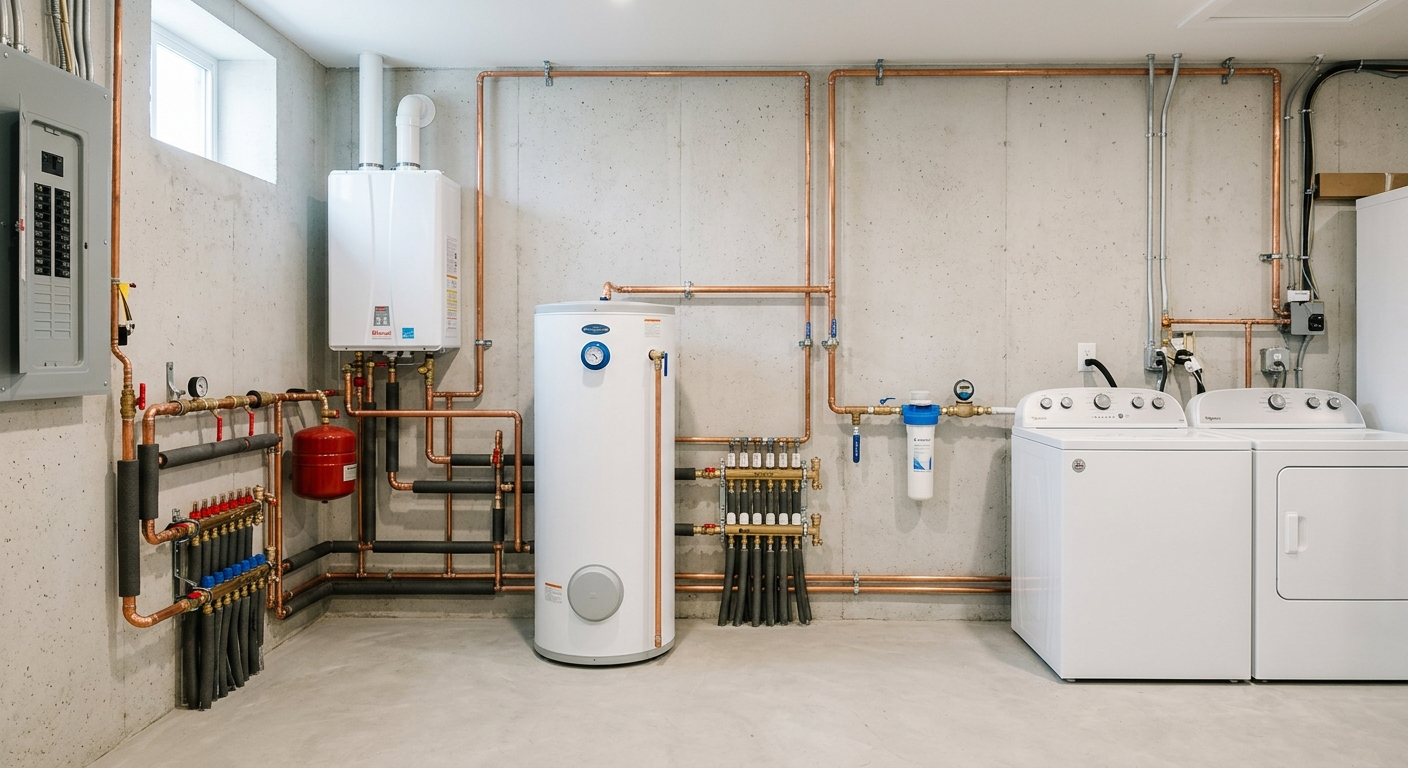
Plumbing services and costs in Grimshaw
In Grimshaw, plumbing service calls tend to start with the kind of weather-driven problems you’d expect in Alberta’s colder northwest, and that reality shows up in both turnaround time and pricing. With 54.2% of homes built before 1981, a lot of local plumbing is older enough to include legacy supply or drain components that are more likely to need partial replacement or even full repiping. The same is true for water-heater work: many older homes are also where hard well or municipal water has contributed to faster scale buildup, shortening tank life.
In the Athabasca–Grande Prairie–Peace River region, freeze risk is a major cost driver. Frost depth typically means supply and sewer lines must be buried well below about 6 ft, and poorly insulated sections—especially outdoor runs, garage lines, or lines routed near exterior walls—are more prone to winter frozen-line and burst-pipe calls. Those emergency jobs are also harder to access during cold snaps, so contractors can be fully scheduled and mobilization costs run higher. On the water side, harder water can increase how often homeowners end up doing flushing, anode replacement, or water-heater changes, particularly when the tank is already near end-of-life.
In Grimshaw, service demand is especially steady around the downtown core and along Main Street, where older service connections and winter access often overlap. If you’re budgeting, the table below gives a realistic starting point for the most common repairs and upgrades in town.
| Service |
What's Included |
Typical Duration |
Price Range |
| Emergency repair (burst pipe, active leak) |
Leak location, isolation, pipe repair/section replacement, basic pressure test, cleanup of accessible work area |
2–6 hours (more if thawing/excavation required) |
$250–$1,200 |
| Water heater replacement (tank, 40–60 gallon) |
Removal and disposal, new tank install, gas/electric hook-up, venting checks (if applicable), leak/pressure check |
4–8 hours |
$1,400–$2,900 |
| Tankless water heater installation |
New unit install, gas sizing/venting verification, power/controls connection, commissioning and flow testing |
1–2 working days |
$2,400–$4,800 |
| Full-home repipe (supply lines, PEX) |
Remove old supply lines, install new PEX/manifolds, pressure test, flushing, wall/ceiling access repairs as quoted |
2–5 working days |
$2,500–$8,800 |
| Drain snaking / hydro-jetting (blocked drain) |
Camera inspection (when needed), snake or jet cleaning, test run, removal of accessible debris |
1–4 hours |
$250–$1,200 |
| Backwater valve installation |
Assessment, valve installation at required location, sealing/connection work, water-test and inspection coordination |
1–2 working days |
$900–$2,400 |
Prices are estimates only and vary by project scope, site access and material selection.
What affects the price of plumbing in Grimshaw
In Athabasca–Grande Prairie–Peace River, you can easily see the same plumbing job quoted 30–50% differently—sometimes due to legitimate scope differences, and sometimes because of how much risk the contractor is carrying for travel, winter access, and hidden damage. In Grimshaw, freeze risk sets the minimum “safe” burial depth and insulation expectations for supply lines, so contractors may include insulation retrofits, heat tracing, or longer crawl/under-slab work if a line is closer to an exterior wall than it should be. When the weather is extreme, after-hours availability also matters: emergency mobilization can move pricing toward the upper end of local bands.
Water hardness is another big variable. Hard water is common across the Prairies and can shorten water-heater life by roughly 20–30% compared with softer supplies, mainly due to scale buildup. That scale can mean more descaling labour, more frequent anode replacement, and a shorter window before you’re shopping for a new tank—especially in homes with older plumbing components. On top of that, older local housing stock increases the likelihood you’ll find galvanized steel supply lines that restrict flow over time, as well as older poly-B systems (and fittings) associated with failure in some homes from the 1980s to mid-1990s in the region.
Two concrete examples from typical Grimshaw work: (1) A “simple” frozen-line repair can become a higher-cost repair if the section requires thawing plus section replacement and insulation remediation. (2) A water-heater change-out may sit in the $1,200–$2,800 range for straightforward swaps, but it can climb if gas venting upgrades or new shutoffs are needed.
| Price Factor |
Why It Matters |
Cost Impact |
| Type of work — repair vs. replacement vs. new install |
Repairs are usually smaller, while replacements/installations include testing, new parts, and code checks |
Repair can be $150–$800; replacements commonly start around $1,200+ |
| Water heater size and fuel type (gas vs. electric vs. tankless) |
Fuel type affects venting, controls, wiring and commissioning; size affects install labour and parts |
Tankless installs often price higher than tank replacements ($2,400–$4,800 typical in Grimshaw) |
| Pipe material — PEX vs. copper vs. CPVC for repiping |
Material choice affects cost of pipe, fittings, and total labour time during rough-in and manifold builds |
PEX is commonly cost-effective for full repipe; copper/CPVC can raise material portions |
| Access — pipes in walls or slab require drywall or concrete cutting |
Hidden runs require more labour, more restoration, and sometimes floor/wall patching |
Access issues can push drain/repiping toward the upper part of local bands ($800–$9,000 for drain work scenarios) |
| Permit requirement — adds cost and inspection scheduling time |
Permits and inspection windows can add administration time and scheduling delays |
Often increases total project cost and moves timelines by days |
| Emergency vs. scheduled — after-hours calls carry a premium |
After-hours service includes dispatch, risk, and higher urgency labour |
Emergency work frequently shifts from “mid-band” to “upper-band” pricing |
| Water hardness — affects water heater sizing and descaling needs |
Hard water accelerates scaling and can require larger maintenance or earlier replacement |
May justify higher-end tank options, warranty coverage, or descaling/flush additions |
| Number of fixtures or drain lines involved |
More locations means more testing, more access, and more parts |
Single-fixture repair stays lower; multi-fixture investigations can multiply labour hours |
Permits & regulations in Alberta
In Alberta, most plumbing work beyond simple fixture replacement must be done by a licensed plumber, and permits are commonly required when you’re changing connections to the water or sewer systems. In practical terms for Grimshaw homeowners, permit requirements typically apply to work like new drain connections or major drain modifications, water-heater changeouts in some municipalities (particularly where a venting or connection change is involved), full repiping, and any work that ties into the municipal water or sewer system. Backwater valve installation is also often recommended in flood-prone Athabasca–Grande Prairie–Peace River areas and typically involves a permit and inspection to confirm correct placement and sealing.
To verify a contractor before work starts, take five minutes and check three things. First, confirm the plumber holds a valid Alberta journeyman or master plumber licence by searching the applicable online registry for their full legal name or company. Second, request a certificate of insurance showing liability coverage—make sure the certificate includes the business as the insured and that coverage is current for the work period. Third, verify they have WSIB/WCB coverage; ask for proof (or a clearance letter where applicable) and keep it for your records.
Step-by-step for your next call in Grimshaw: ask for the licence number, request the current certificate of insurance and WSIB/WCB documentation, then ask whether a permit is required for your specific scope and whether they will handle the permit pull and inspection scheduling. A reputable contractor should answer those questions clearly without pushing you to “just sign and we’ll sort it out later.”
Common plumbing problems in Grimshaw homes and how to fix them
Here are the five most common plumbing issues I see in Grimshaw homes—and what to do about them—grounded in the region’s cold-weather freeze risk and older housing stock. (1) Burst or frozen pipes: freezing usually happens at exterior runs, garage lines, or poorly insulated sections. Prevention is straightforward—insulate the right areas, keep cabinet doors open where pipes are inside, and consider heat trace on vulnerable outdoor/garage supply runs. If a pipe bursts, treat it like an emergency: shut off the water immediately and call a plumber so repairs can include thaw-safe methods and proper re-insulation to prevent repeat failures.
(2) Aging pipe materials: galvanized steel can corrode internally, leading to restricted flow and discoloured water, while poly-B can experience brittleness and fitting-related failure. With 54.2% of homes built before 1981 in the broader Grimshaw area, it’s common to see galvanized sections; if you’re already dealing with recurring leaks or pressure problems, proactive repiping can cost less than repeated stop-gap repairs.
(3) Water heater end-of-life: tank vs. tankless depends on use patterns, gas/electric availability, and maintenance expectations. With hard water contributing to scale buildup, tanks often need more attention and may reach replacement sooner; tankless can still work well, but it must be sized correctly and maintained with descaling in a hard-water environment.
(4) Low water pressure throughout the home: plumbers typically diagnose by checking aerators first, then moving to main-line restrictions (common with corroded galvanized runs) and possible municipal pressure fluctuations. (5) Drain issues: slow or blocked drains can be root intrusion, buildup, or failed older cast-iron sections—camera inspection helps separate “snake-and-clear” from “repair the line.”
Dollar example: a blocked drain might start in the $250–$1,200 range with snaking or hydro-jetting. If a camera reveals a damaged section requiring partial drain repair, you can move into the repiping/drain work pricing band (often $800–$9,000 depending on access and excavation). Spending on an inspection up front often prevents paying for repeated cleanouts.
| Issue |
Common Cause in Grimshaw |
Typical Fix |
Price Band |
| Burst or frozen pipe |
Uninsulated exterior/garage runs, shallow winter burial, rapid freeze-thaw cycles |
Thaw-safe repair, replace damaged section, add insulation/heat trace where required, retest and flush |
$250–$1,200 |
| Low water pressure throughout home |
Corroded galvanized supply lines, sediment buildup, municipal pressure drop during peak usage |
Pressure testing, aerator checks, flushing/cleaning, then partial or full repipe if restriction is confirmed |
$150–$1,800 |
| Slow or blocked drain |
Hair/grease buildup, mineral scale from hard water, occasional root intrusion in older drain lines |
Snake or hydro-jetting, camera inspection, spot repair if a damaged section is found |
$250–$1,500 |
| Leaking or failed water heater |
Tank corrosion, anode depletion accelerated by hard water scale, valve/connection failure |
Replace tank, replace supply shutoffs if needed, venting/gas or electrical checks, pressure/leak testing |
$1,400–$2,900 |
| Poly-B pipe failure (fitting or pipe crack) |
Older installations where fittings weakened or brittle sections crack over time |
Section replacement or reroute to PEX/manifold, pressure tests, update affected branch lines |
$800–$4,200 |
| Galvanized pipe corrosion (restricted flow, discolouration) |
Internal corrosion and mineral buildup restricting flow, discoloured water at fixtures |
Flushing/assessment, partial repipe or full-home repipe with new PEX, water quality checks |
$2,500–$8,800 |
How to choose a plumbing contractor in Grimshaw
Choosing the right plumber in Grimshaw starts with verification. First, confirm Alberta licensing: ask for the journeyman/master plumber licence number and check it against the provincial online registry for the correct name. Second, verify liability insurance by requesting a current certificate of insurance—don’t accept “it’s in the truck.” Third, confirm WSIB/WCB coverage (or the appropriate clearance paperwork where applicable). A licensed company with active coverage is better prepared for unexpected damage and protects you if an incident occurs on site.
Next, get 2–3 itemised written quotes. You want a breakdown that separates labour, materials, and any specialty items like disposal fees, camera inspection, insulation restoration, or heat-trace cable. Avoid “lump sum only” quotes unless the scope is very clearly defined. Read exclusions carefully: will they pull permits (if required), is disposal included, and are drywall/concrete restoration costs covered or quoted separately?
Warranty matters too. Ask for both the workmanship warranty length and the manufacturer’s product warranty details—especially for water heaters and backwater valves. Clarify if manufacturer warranty is dependent on having the unit installed by a licensed contractor and whether any warranty transfer is possible if you sell the home. For payment, never pay more than 10–15% upfront; hold back until the job is complete and tested. Finally, get a written start date and completion estimate so you’re not waiting through winter access delays.
- Verify Alberta licence number before booking a site visit.
- Request a certificate of liability insurance (current dates, correct insured).
- Confirm WSIB/WCB coverage and keep the proof for your records.
- Get itemised quotes (labour + materials) rather than a single total.
- Ask if permits are required for your exact scope and who pulls them.
- Confirm disposal is included (old tank, fittings, cut-out sections).
- Check whether camera inspection is included for drain problems.
- Ask about freeze-protection work: insulation/heat trace where needed.
- Ensure the quote states what “access” repairs are included (drywall patching, concrete reinstatement).
- Request the workmanship warranty in writing and what it covers.
- Set a payment schedule: small deposit, then progress payments, final after testing.
- Get a written timeline and who notifies you if the schedule changes.
Red flags I see too often in small-town Alberta plumbing: vague scopes (“we’ll see what happens”), no licence/insurance proof when asked, quotes that don’t mention permit handling when the work involves drains, water connections, or backwater valves, warranties stated only verbally, and contractors asking for large upfront payments (beyond 10–15%).
Frequently asked questions — plumbing in Grimshaw
How do I compare plumbing quotes?
Start by comparing apples to apples. In Grimshaw, quotes for the same “leak repair” can differ because one contractor includes freeze-proofing (insulation/heat trace), while another only replaces the damaged section. Ask for an itemised breakdown: labour hours, materials, disposal, and any diagnostic tools (for example, a camera inspection for drains). Confirm what’s included in the scope—especially whether permits are required for drain connections or major water work and who pulls them. Also compare warranty terms and the payment schedule. If one quote lands at the low end, ask what they’re not including. For water-heater replacements, you should expect something like $1,400–$2,900 for a typical tank swap, unless venting/electrical work expands the scope.
How long does a water heater replacement take in Grimshaw?
Most tank water-heater replacements in Grimshaw take about 4–8 hours once the unit is on site, assuming proper access and that shutoffs/venting conditions are straightforward. In colder weather, extra time may be needed for safe removal and leak testing, and if the job uncovers older connections or fittings that need replacement. When the install involves additional gas venting checks or changes to valves and piping, plan for longer on the day. If you’re switching to a tankless unit, the timeline is usually more like 1–2 working days for proper commissioning and flow/temperature verification. Pricing also changes with scope; a typical tank replacement often falls around $1,400–$2,900 depending on the exact tank and site conditions.
What is a backwater valve and do I need one in Grimshaw?
A backwater valve is a one-way mechanism installed on a home’s drain line to help prevent sewage or storm water from backing up into your basement during heavy rain, rapid melt, or sewer pressure surges. In the Athabasca–Grande Prairie–Peace River region, that risk can be relevant for many homeowners because of freeze-thaw cycles and seasonal water loading. Whether you “need” one depends on your basement plumbing layout, local drainage patterns, and how your main drain is configured. If you have a basement toilet, floor drains, or you’ve experienced sewer odours or basement backups before, it’s worth discussing. The installation typically requires a permit and inspection in many cases, and pricing in Grimshaw commonly starts around $900–$2,400 depending on location and access.
How do I shut off the water supply in my Grimshaw home?
Most homes have a main shutoff valve near where the service enters the house (often in a basement utility area, mechanical room, or near the water meter). To shut off water safely, locate the shutoff, then turn the valve fully clockwise until it stops. If you’re dealing with an active leak, turn off the water first, then open a nearby tap to relieve pressure and help prevent additional dripping. If your shutoff is stuck (which can happen in older homes), don’t force it to the point of breakage—call a plumber for safe isolation. In a freeze event, also consider any exposed lines: avoid opening up walls yourself if you suspect pipes may still be frozen in sections. For older Grimshaw homes (many built before 1981), knowing where the shutoff is matters because winter burst events can expand quickly.
Can I claim a plumbing repair on home insurance in Alberta?
Sometimes, but it depends on the cause of the damage and the coverage in your policy. For example, insurance is more likely to cover sudden and accidental events like a burst pipe (especially when you can show reasonable maintenance and reasonable care during freezing conditions). It’s often less likely to cover issues from long-term neglect such as chronic leaks you knew about but didn’t repair. To improve your chances, document the damage, keep receipts for the plumber’s work, and ask the plumber to include what was found and what was repaired. In Alberta, insurance claim processes are governed by your insurer and your specific policy terms, not by plumbing company practices. When budgeting your options, emergency repairs often land around $250–$1,200, so having documentation helps even when you’re only claiming part of the loss.
How do I prevent drain clogs in my Grimshaw home?
Prevention is mostly about what you put down the drains and catching early warning signs. Use drain strainers to stop hair and debris in showers and tubs, avoid flushing grease (it can solidify in cold conditions), and don’t overfill garbage disposals with fibrous food scraps. For hard-water homes, mineral buildup can contribute to slow drains over time, so periodic flushing is helpful where appropriate. If a drain starts to gurgle or slow down, address it early—don’t wait until it’s fully blocked. In a winter climate like Grimshaw, frozen or stressed plumbing can also worsen drainage problems, so keep bathroom and laundry areas insulated if pipes run along exterior walls. When clogs happen, a plumber may start with snaking or hydro-jetting, often priced around $250–$1,200, but camera inspection can prevent repeat visits if the cause is root intrusion or a damaged line.