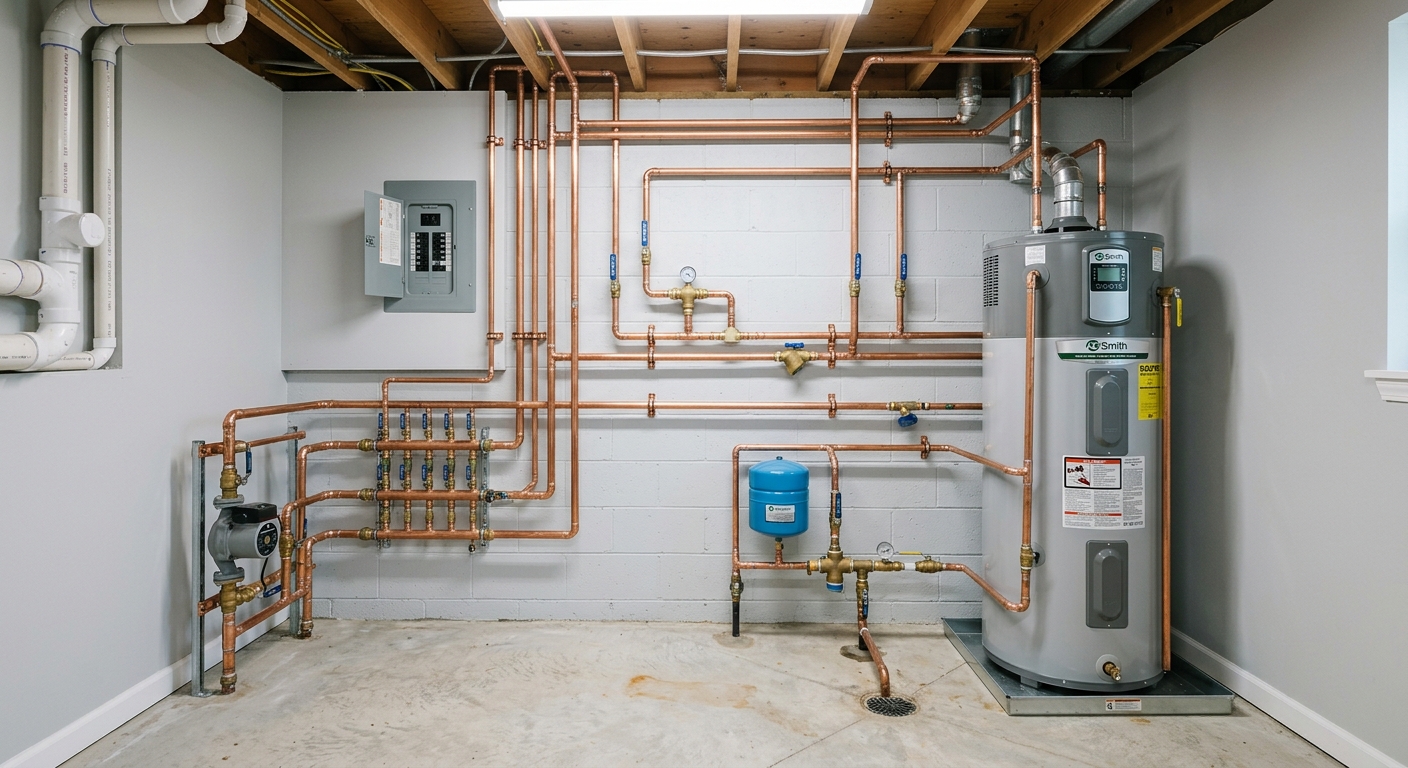
Plumbing services and costs in Revelstoke
Revelstoke homeowners typically call plumbers for two things: winter freeze protection and aging-system repairs. With 66.4% of homes built before 1981, a lot of local plumbing is now past its “set-and-forget” window, and that’s when supply-line corrosion, older fittings, and water-heater wear show up more often. At the same time, Revelstoke’s housing base is homeowner-heavy—2,510 homeowner households, representing 74.9% of households (Statistics Canada, 2021 Census)—so many repairs are done promptly rather than deferred.
In the Thompson–Okanagan, cold snaps and sustained sub-zero stretches drive up burst-pipe and freeze-repair calls, especially on properties with exterior runs, crawlspaces, and lines close to grade. Meanwhile, moderately to very hard water common in the region speeds mineral buildup in tank heaters and shortens anode life, so descaling and heater replacement become recurring budget items. Labour demand also spikes in winter when access is tougher—think hillside lots and lake-adjacent neighbourhoods where digging and crawlspace work take longer.
In Revelstoke, areas such as downtown and the older housing pockets on the hillsides (where renovations often reveal legacy piping) tend to see more urgent service calls. Below is a practical price range comparison for common jobs, so you can benchmark quotes before you commit to a contractor.
| Service |
What's Included |
Typical Duration |
Price Range |
| Emergency repair (burst pipe, active leak) |
Locate leak, shutoff, isolate section, repair/replace affected pipe/valve, pressure test, basic cleanup; may include partial drywall access |
2–8 hours (often same day) |
$180–$800 |
| Water heater replacement (tank, 40–60 gallon) |
Remove old unit, install new tank, connect supply/venting as required, pressure relief discharge line, test/commission |
4–8 hours |
$1,200–$2,200 |
| Tankless water heater installation |
Assess capacity, install unit and hookups, gas/electrical integration as needed, venting/condensate handling, commissioning |
1–2 days |
$2,200–$4,000 |
| Full-home repipe (supply lines, PEX) |
Shutoff and drain, remove/replace supply piping, new PEX routing, new shutoffs/valves, pressure test, wall/cavity access patching coordination |
3–7 days |
$4,500–$12,000 |
| Drain snaking / hydro-jetting (blocked drain) |
Camera check (if needed), snake or jetting, clear roots/debris, confirm flow and run water test |
1–3 hours |
$180–$1,200 |
| Backwater valve installation |
Assess sewer line alignment, install backwater valve, connect to main drain, test flow and prevent reverse backup |
1–2 days |
$1,200–$2,800 |
Prices are estimates only and vary by project scope, site access and material selection.
What affects the price of plumbing in Revelstoke
In Revelstoke and across the Thompson–Okanagan, the same plumbing problem can land with quotes that vary by roughly 30–50% depending on access conditions, what the plumber discovers once walls are opened, and whether the job is repaired or replaced. A winter leak that requires after-hours labour will almost always price differently than a scheduled replacement on a normal weekday. Similarly, an inspection-based “clear the blockage” call can become a larger drain renewal project once root intrusion or a failed section of older pipe is confirmed.
Freeze risk is a major driver. How deep supply lines must be buried in this region determines whether exterior/garage runs need insulation upgrades or heat trace cable to reduce burst-pipe probability. If lines were installed too shallow—or they’re too close to grade—contractors often recommend additional insulation and re-routing, which adds materials and labour. Water hardness also matters: moderately to very hard water accelerates scale buildup in tank heaters, reduces efficiency, and shortens anode life. That can push replacement cycles earlier, and it’s a reason tank heater work in the $1,200–$2,200 band is common.
Older housing stock also affects labour time. In homes from the 1980s to mid-1990s, legacy materials such as galvanized steel (corrosion and restricted flow) and poly-B (brittleness and fitting issues) are sometimes present across the Thompson–Okanagan. If those sections are involved, plumbers may suggest proactive repiping rather than repeated patch repairs.
Concrete examples: (1) A simple repair might sit in the $180–$800 range when a valve or short section can be isolated quickly; (2) but once multiple rooms share the same aging trunk lines and access is through drywall or tight cavities, repipe options can quickly move toward the $4,500–$12,000 range. In short, what looks “small” on the first call often expands once the plumber confirms piping condition and winter exposure risk.
| Price Factor |
Why It Matters |
Cost Impact |
| Type of work — repair vs. replacement vs. new install |
Replacement needs extra labour for removal, re-connections, testing, and sometimes venting or discharge adjustments |
Can add hundreds to several thousand dollars |
| Water heater size and fuel type (gas vs. electric vs. tankless) |
Gas/venting and electrical requirements change installation complexity and safety checks |
Tank installs often in the $1,200–$2,200 band; tankless typically higher |
| Pipe material — PEX vs. copper vs. CPVC for repiping |
Material and fitting compatibility can affect time, availability, and long-term performance |
Different materials can shift the job by thousands |
| Access — pipes in walls or slab require drywall or concrete cutting |
Opening finished surfaces increases labour, disposal, and patching coordination |
Often the biggest hidden cost in older homes |
| Permit requirement — adds cost and inspection scheduling time |
Permits and inspections can delay starts and require documentation |
Typically adds scheduling and administration costs |
| Emergency vs. scheduled — after-hours calls carry a premium |
Dispatch priority, travel time, and risk of limited material staging increase rates |
Emergency work can be 1.2× to 1.6× |
| Water hardness — affects water heater sizing and descaling needs |
Hard water drives mineral scale and shorter anode life, influencing whether upgrades are recommended |
Can increase heater replacement frequency and add maintenance |
| Number of fixtures or drain lines involved |
More stops, branches, or affected drains mean more isolation, testing, and restoration time |
Linear increases in labour; can become a multi-day job |
Permits & regulations in British Columbia
In British Columbia, most plumbing work beyond simple fixture replacement must be performed by a licensed plumber. As a homeowner in Revelstoke, the key is knowing what typically triggers permits and inspections, especially when you’re dealing with main connections or anything that changes how water or waste flows to the municipal system.
Work that typically requires a permit (and inspection) includes: new drain connections, any work that ties into the municipal water or sewer system, full repiping, and water-heater changeouts in some municipalities. Backwater valve installation is often recommended in Thompson–Okanagan flood-prone areas and typically requires a permit and inspection as it modifies sewer-flow protection.
Work that typically does NOT require a permit is limited—commonly, small repairs that don’t alter the plumbing system’s connection points (for example, replacing a minor shutoff valve or repairing an accessible section) may not require a permit. However, permit requirements can still vary by scope, and the safe approach is to ask the plumber to confirm whether a permit is required before work starts.
To verify your contractor, ask for their British Columbia plumber licence number and confirm it through the online licensing registry. Request a certificate of insurance showing liability coverage, and ask how they handle WCB/WCB clearance (coverage is often documented as WCB or clearance letter depending on the company). A reputable Revelstoke plumber should provide these quickly before quoting and should include permit handling (if required) in the written scope.
Common plumbing problems in Revelstoke homes and how to fix them
Revelstoke’s winter conditions and older housing stock make certain plumbing issues show up again and again. Here are five of the most common problems and what a licensed plumber typically does to solve them.
1) Burst or frozen pipes: When supply lines are too shallow, insufficiently insulated, or run through cold crawlspaces/garage edges, they can freeze and burst during sustained sub-zero weather. Prevention is usually insulation upgrades, improved routing, and sometimes heat trace cable on exterior runs. When it happens, response is urgent: shut off water, open affected areas safely, locate the leak, repair, then pressure test before closing up. Emergency repairs often land in the $180–$800 range when the damaged section is accessible.
2) Aging pipe materials: Galvanized steel can corrode internally, restricting flow and trapping scale. Poly-B can become brittle, with fittings and joints failing over time. If multiple fixtures are affected or you’re seeing repeated leaks, proactive repiping is often more cost-effective than piecemeal patches—this is where repipe budgets commonly move into the $4,500–$12,000 range.
3) Water heater end-of-life: Hard water increases scale buildup, shortens anode life, and pushes heaters to fail sooner. Tank units are usually straightforward to replace; tankless can be a better investment when you want improved energy efficiency and consistent hot water, but it depends on venting and capacity. In many cases, tank replacement sits around the $1,200–$2,200 band.
4) Low water pressure throughout the home: Causes include clogged aerators, municipal pressure drops, corroded galvanized lines, or partially blocked shutoffs. Plumbers diagnose with pressure testing, valve inspection, and sometimes inspection of likely bottlenecks.
5) Drain issues: Blockages can be simple debris, root intrusion, or failing cast-iron sections in older homes. Jetting or snaking clears many clogs, but if the line is deteriorating, camera inspection often changes the plan to partial or full drain replacement.
Example to justify choices: if you pay a recurring $180–$800 repair every winter for a freeze-prone exterior line, insulation and re-routing may cost more upfront but can prevent repeated emergency callouts and damage restoration.
| Issue |
Common Cause in Revelstoke |
Typical Fix |
Price Band |
| Burst or frozen pipe |
Supply lines too close to grade, insufficient insulation, crawlspace exposure during prolonged cold |
Shutoff and repair/replace section, add insulation/heat trace where needed, pressure test and restore |
$180–$800 |
| Low water pressure throughout home |
Corroded galvanized lines, partially closed shutoff valves, debris in aerators, pressure drop |
Diagnostic pressure tests, clean/replace aerators and valves, address pipe restriction if found |
$250–$1,200 |
| Slow or blocked drain |
Grease buildup, hair/debris, root intrusion in older runs, tree-root or slope issues |
Snake/jetting, camera inspection, localized repair if pipe condition allows |
$180–$1,200 |
| Leaking or failed water heater |
Tank wear, anode depletion accelerated by hard water scaling, corroded connections |
Replace tank, connect safely, verify venting/discharge, test and commission |
$1,200–$2,200 |
| Poly-B pipe failure (fitting or pipe crack) |
Joint/fitting failures and brittleness over time in homes built or plumbed during the era |
Locate failed section, replace with compatible modern piping, pressure test and restore |
$1,500–$8,000 |
| Galvanized pipe corrosion (restricted flow, discolouration) |
Internal scaling and corrosion from age; sediment restricts flow and causes noisy valves/colour |
Repair isolated sections or plan partial/full repipe depending on spread |
$1,500–$12,000 |
How to choose a plumbing contractor in Revelstoke
Choosing a plumber in Revelstoke is mostly about verifying credentials, then locking down scope in writing. First, confirm British Columbia licensing: ask for the plumber’s licence number and ensure it matches a valid BC journeyman or master plumber listing. For safety and cost protection, request a certificate of insurance that includes liability coverage. Also ask for proof of WCB/WCB clearance documentation (depending on the employer’s status, this is commonly provided as a clearance letter). Don’t rely on verbal assurances—have them email the documents before work begins.
Next, get 2–3 itemised written quotes. A good quote breaks labour and materials apart (pipe, fittings, heater unit, disposal, and any camera inspection) rather than using a single lump sum. Ask whether permits are included in the quote if the job involves a new connection, full repipe, or other system changes. Confirm what’s excluded: drywall patching, concrete cutting, disposal of removed materials, and after-hours charges.
Warranty matters too. Look for a workmanship warranty (often provided for a defined period) and confirm what’s covered under the product/manufacturer warranty. Ask if the manufacturer warranty is transferable when you sell the home.
Payment schedule: never pay more than about 10–15% upfront. Hold back the remainder until the work is complete and tested. Finally, require a start date and completion estimate in writing so a winter schedule doesn’t stretch into repeated emergency access costs.
- BC licence number provided on the quote and invoice
- Liability insurance certificate received before starting
- WCB/WCB clearance proof provided
- Itemised breakdown (labour, parts, disposal, inspection)
- Permit handling stated clearly (included or extra)
- Camera inspection included if drains are suspected to involve roots
- Explicit scope on what gets opened (and who patches)
- Workmanship warranty terms written in the paperwork
- Manufacturer warranty details and whether it’s transferable
- After-hours/emergency premium disclosed up front
- Payment plan limited to 10–15% upfront
- Written start date and completion timeline
Red flags to watch in Revelstoke: vague “we’ll figure it out” scopes, refusal to provide insurance/WCB or licence info, no written warranty terms, quotes that aren’t itemised (especially for heater or repipe work), and pressure to pay most of the balance before testing and cleanup.
Frequently asked questions — plumbing in Revelstoke
How long does a water heater replacement take in Revelstoke?
In Revelstoke, a standard tank water heater replacement typically takes about 4–8 hours, assuming the old unit is accessible and the new size/type matches what the plumber can install on-site without major venting changes. In homes with older plumbing runs or mineral-scaled connections (common with hard water in the Thompson–Okanagan), extra time may be needed to remove stubborn parts safely and get a clean, reliable connection. As a reference point, tank replacements are often priced in the $1,200–$2,200 band, and that range usually assumes normal access. If the job requires permit steps or additional upgrades (like discharge piping adjustments), time can extend into the next day.
What is a backwater valve and do I need one in Revelstoke?
A backwater valve is a mechanical device installed on your sewer drain line to prevent sewage from flowing back into your home during sewer backups or heavy water events. In the Thompson–Okanagan, this is especially relevant for basement drain protection and homes near areas where surface runoff or higher water events can increase backup risk. Many homeowners choose one when they have basement plumbing, a floor drain, or a history of gurgling/drain reversals. Because it modifies your drainage protection and may involve permitting, your Revelstoke plumber should confirm whether a permit and inspection are required. Backwater valve installations are commonly quoted in the $1,200–$2,800 range, depending on access and connection complexity.
How do I shut off the water supply in my Revelstoke home?
Start by locating your main shutoff valve, which is typically near where the service enters the home (often at the basement perimeter, utility room, or near a mechanical area). If you have shutoffs for specific fixtures, you can use those for local problems, but for active leaks you want to isolate the entire water supply when possible. Before an emergency, test the shutoff gently—open/close slightly—so you know it moves. During a freeze-related event, shutoff plus opening the lowest nearby tap to relieve pressure can help reduce damage while you wait for a licensed plumber. In older Revelstoke homes (Statistics Canada, 2021 Census shows many homes are older), valves may be corroded, so avoid forcing them without knowing the condition. If you can’t safely shut off, call for emergency service.
Can I claim a plumbing repair on home insurance in British Columbia?
Some plumbing repairs may be claimable in British Columbia, but it depends on your policy and the cause of the damage (for example, sudden and accidental leaks are more often considered than gradual wear). Insurance commonly focuses on water damage beyond the plumbing component itself—so even if the pipe repair isn’t covered, the resulting drywall, flooring, and remediation might be. For freeze-related damage, insurers often look at whether reasonable steps were taken to protect against freezing. In Revelstoke, where burst-pipe risk is real in hard winter periods, documentation helps: show insulation/heat-trace steps you took, and keep invoices for emergency repairs. Always contact your insurer first and ask about the required claim process, what evidence they want, and whether you need pre-approval for remediation.
How do I prevent drain clogs in my Revelstoke home?
Prevention is mostly about keeping solids and oils out of drains. In older Revelstoke plumbing, slow drains can also mean roots or aging cast-iron sections, so early action matters. Use a strainer in sinks and avoid flushing grease, coffee grounds, wipes, or paper products. Run hot water regularly (not boiling) and consider periodic maintenance through safe drain cleaning—your plumber can recommend a method that doesn’t damage older pipes. If you notice recurring slowdowns, get a camera inspection instead of only snaking—this helps identify root intrusion or a failing section. A simple snaking/jetting call is often quoted in the $180–$1,200 range, but root-related repairs and drain renewals can cost more, so catching the issue early usually saves money.
What is the difference between ABS and PVC pipe?
ABS and PVC are both plastics used for drain and vent piping, but they differ in material properties and installation expectations. ABS (often used in some drain/vent systems) is generally more impact-resistant at colder temperatures, while PVC is often more rigid and is commonly chosen for chemical resistance and availability. In Canadian home renovations, compatibility with existing pipe fittings and local installation practices matters as much as the material label. If you’re repairing older Revelstoke plumbing, a licensed plumber will check what’s already installed behind walls and confirm the correct primer/cement and transition fittings to use. The safest goal is a proper, leak-tested connection—not just “matching” colours. If you’re unsure, ask for confirmation of pipe type and joining method in your written quote.