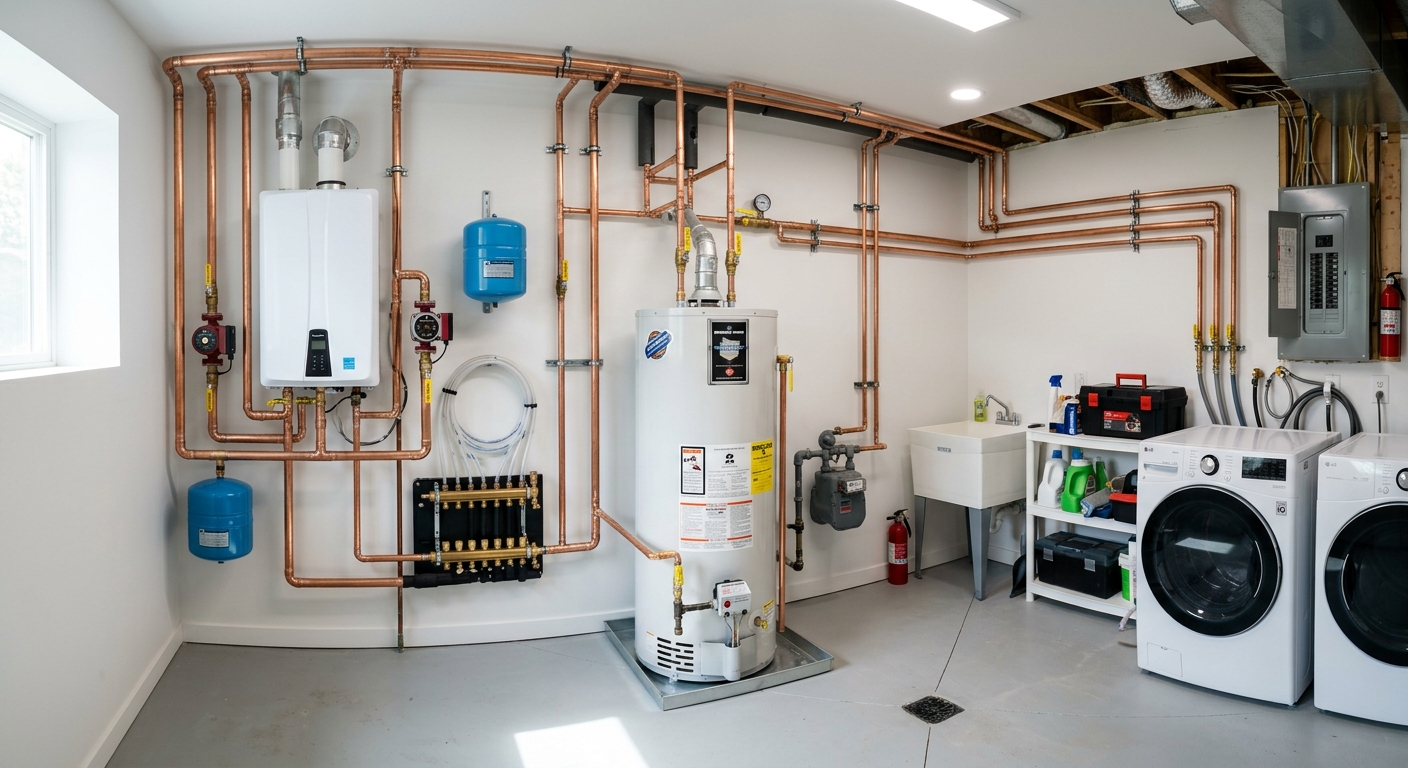
Plumbing services and costs in West Vancouver
Plumbing service in West Vancouver is shaped by a unique mix of affluent, older housing stock and a shoreline climate that’s mild overall—but still freeze-prone during cold snaps. With 53.8% of homes built before 1981, many properties in neighbourhoods like Cypress Village and Caulfeild are more likely to have aging supply lines, older water heaters, and older drain materials that start causing problems long before they look “bad” to the untrained eye (Statistics Canada, 2021 Census). In the Lower Mainland–Southwest, costs can climb quickly once a leak occurs because the plumbing repair is often modest compared with water-damage restoration. That’s especially true in unheated garages, exterior walls, and crawlspace-style areas where shallow lines can be affected by short deep-cold events.
Contractors also face market constraints: demand for leak response, winter call-outs, and drain work stays consistently high because many homeowners wait until they see discolouration, reduced pressure, or slow drains. When pipes freeze and burst, insurers and restoration timelines can add coordination steps, but experienced plumbers can often stop the damage fast and isolate the section that needs replacement. That’s why West Vancouver homeowners often see emergency rates in winter higher than summer—an after-hours call may be only a few hours of work, but it includes diagnostics, travel, and priority scheduling.
Below is a practical pricing comparison of common jobs so you can benchmark quotes before comparing scope and materials.
| Service |
What's Included |
Typical Duration |
Price Range |
| Emergency repair (burst pipe, active leak) |
Leak location, isolation/valve shutoff, pipe section repair or temporary bypass, pressure check; excludes major restoration |
2–6 hours (plus restoration coordination) |
$150–$700 |
| Water heater replacement (tank, 40–60 gallon) |
Remove/haul-away old unit, install new tank, hookups (gas or electric), venting checks where applicable, startup and testing |
4–8 hours |
$1,400–$3,500 |
| Tankless water heater installation |
Site assessment, install unit, gas/electrical and venting/condensate handling, commissioning and safety checks |
1–2 days |
$1,800–$4,200 |
| Full-home repipe (supply lines, PEX) |
Remove legacy lines, install new PEX trunk lines and branches, shutoff upgrades, pressure testing; patching/finishing handled to agreed scope |
2–5 days |
$3,500–$18,000 |
| Drain snaking / hydro-jetting (blocked drain) |
Camera inspection (if needed), clear obstruction, jetting where suitable, confirm flow; minor spot fixes only if identified |
1–4 hours |
$180–$900 |
| Backwater valve installation |
Confirm discharge path and basement/sanitary configuration, install backwater valve, test for proper operation; permit/inspection if required |
4–8 hours |
$600–$1,800 |
Prices are estimates only and vary by project scope, site access and material selection.
What affects the price of plumbing in West Vancouver
In West Vancouver and across the Lower Mainland–Southwest, it’s common to see quotes for the “same” plumbing problem differ by 30–50%. The biggest reasons are not just the final material choice—it’s the access conditions (how many walls or ceilings must be opened), whether the plumber proposes a repair versus a replacement, and how much diagnostic work they include before pricing. Labour rates and scheduling also matter: winter call-outs and coordinated permit/inspection timing can add cost even when the actual plumbing labour is short.
Climate risk changes how much preparation must happen. Freeze-prone cold snaps determine how deep outdoor supply lines must be buried or insulated, and whether heat trace is recommended for garage or exterior wall runs. In practice, that’s why a “simple” leak or pressure complaint can lead to uncovered insulation work or heat-trace adjustments—especially when lines sit in borderline areas that freeze during a multi-day cold spell.
Water hardness also affects equipment lifespan and maintenance scope. Harder water common in parts of Canada can shorten tank-type heater life by 20–30% through scale buildup, and it also contributes to clogging aerators and showerheads over time. Even in the Lower Mainland–Southwest, mineral content can leave deposits that reduce performance. For older regional homes—many from the 1980s to mid-1990s—legacy galvanized supply lines can restrict flow, while poly-B piping (where present) can fail at fittings. Those conditions often push the job from a smaller repair into a repipe priced closer to the $3,500–$18,000 band rather than the smaller $150–$700 emergency band.
Two practical examples: (1) A drain that looks blocked might just need snaking within the $180–$900 band, but if camera inspection shows root intrusion on older clay/cast-iron sections, the scope can expand. (2) A water-heater “swap” can stay near $1,400–$3,500 when venting/electrical and platform access are straightforward; it rises when venting upgrades, gas fitting changes, or hard-to-access wall penetrations are required.
| Price Factor |
Why It Matters |
Cost Impact |
| Type of work — repair vs. replacement vs. new install |
Repairs are targeted; replacements often require removal/haul-away, code-compliant connections, and testing |
Can swing by 30–60% |
| Water heater size and fuel type (gas vs. electric vs. tankless) |
Fuel type changes venting/electrical and parts; tankless may require condensate and larger vent planning |
Typically adds $300–$1,500+ |
| Pipe material — PEX vs. copper vs. CPVC for repiping |
Material choice affects labour speed, connector style, and compatibility with existing systems |
Can move the job up or down $500–$4,000 |
| Access — pipes in walls or slab require drywall or concrete cutting |
Hidden pipe routes increase demolition and restoration work |
Often the largest variable after scope |
| Permit requirement — adds cost and inspection scheduling time |
Inspections delay start/completion and may require documentation |
Can add $150–$600+ depending on complexity |
| Emergency vs. scheduled — after-hours calls carry a premium |
Priority dispatch, night/weekend labour, and material truck runs cost more |
Commonly $200–$800+ |
| Water hardness — affects water heater sizing and descaling needs |
Hardness accelerates scale buildup and affects maintenance schedules and parts wear |
Can reduce heater life by 20–30% |
| Number of fixtures or drain lines involved |
More fixtures means more branch connections, testing, and potential follow-up leaks |
Can add $300–$2,500+ |
Permits & regulations in British Columbia
In British Columbia, most plumbing work beyond simple fixture replacement must be performed by a licensed plumber. In practice, permit requirements commonly include new drain connections, water-heater changeouts in certain municipal scenarios, full repiping, and any work that connects to the municipal water or sewer system. Backwater valve installation is typically recommended in Lower Mainland–Southwest basements due to surcharge/flooding risk, and it often requires a permit and inspection as well. Because rules can vary by scope and municipality, your contractor should confirm the permit plan before work begins and provide inspection dates or permit references if required.
For your West Vancouver project, use this step-by-step verification approach before the first cut. First, ask for the contractor’s British Columbia licence number (journeyman or master, depending on their role) and check it through the provincial licensing registry online. Second, request a certificate of insurance showing current general liability coverage and ensure the plumber (or company) is listed as the insured party. Third, confirm their workers’ compensation coverage (WSIB/WCB). You should be able to obtain proof of coverage during quote finalization; don’t proceed without it.
Finally, for any job requiring a permit, ask the plumber who pulls the permit and whether disposal/cleanup is included. A legitimate contractor will also provide a clear start date, specify what will be inspected, and document results after pressure testing, venting checks, or camera inspections.
Common plumbing problems in West Vancouver homes and how to fix them
West Vancouver homes tend to experience five plumbing problems repeatedly because of the combination of older construction (many homes built before 1981) and a coastal climate that can still produce freeze-prone cold snaps. First, burst or frozen pipes: prevention starts with insulated exterior runs, sealed penetrations, and—where needed—heat trace on borderline garage or crawl/interior-to-exterior transitions. When a freeze happens, the response matters more than the repair alone: shut off water fast, isolate the affected section, and keep the restoration team ready because water damage can outsize the plumbing bill.
Second, aging pipe materials: galvanized steel can corrode, restricting flow and causing discolouration, while poly-B (where present in the Lower Mainland) can fail at fittings. If you’re seeing repeated leaks or pressure loss in older zones, proactive repiping into PEX is often cheaper than “repairing around” a failing network.
Third, water heater end-of-life: tank units are straightforward but can scale up faster in harder-water conditions, which reduces efficiency and increases maintenance. In some households, a tankless unit becomes a better investment when hot-water demand is steady and the venting plan is appropriate—otherwise, the simpler tank replacement near $1,400–$3,500 may be the smarter short-term choice.
Fourth, low water pressure throughout the home: plumbers usually start with aerators and shutoffs, then check for corroded galvanized sections and supply restrictions. Fifth, drain issues: slow drains can be blockage, root intrusion, or failed cast-iron/clay lines. In older West Vancouver neighbourhoods, camera inspection frequently prevents guessing.
For example, if a drain is just partly blocked, snaking might stay within $180–$900. If camera footage shows recurring root intrusion or compromised pipe joints, that “small fix” could become a repeat visit; replacing the affected section (or planning a staged drain repair) is often justified to stop repeated cleanouts and excavation.
| Issue |
Common Cause in West Vancouver |
Typical Fix |
Price Band |
| Burst or frozen pipe |
Cold snaps affecting exterior runs, garage lines, or shallow uninsulated sections during temporary subfreezing periods |
Locate leak, shut off, repair/replace section, insulate and add heat trace if needed |
$150–$700 |
| Low water pressure throughout home |
Corroded galvanized supply, partial obstruction at older fittings, or combined pressure drop from restricted sections |
Diagnostic checks, replace restricted sections, flush/clean where appropriate, pressure test |
$250–$1,400 |
| Slow or blocked drain |
Hair/soap buildup plus older drain line performance issues; in older areas, root intrusion is common |
Camera inspection, snake/jet, address affected section if roots/failed joints are found |
$180–$900 |
| Leaking or failed water heater |
Tank corrosion and scale buildup reducing efficiency; aging units in older West Vancouver homes |
Replace tank, check venting, confirm electrical/gas connections and safe operation |
$1,400–$3,500 |
| Poly-B pipe failure (fitting or pipe crack) |
Legacy poly-B fittings and connections in homes built in the 1980s to mid-1990s; progressive failure under pressure cycles |
Remove failed section first (if limited) or plan full repipe with PEX for long-term reliability |
$3,500–$18,000 |
| Galvanized pipe corrosion (restricted flow, discolouration) |
Corrosion from the inside narrowing water paths and causing discoloured water and repeated valve issues |
Flush/diagnose; replace affected branch sections or full repipe to restore flow |
$3,500–$18,000 |
How to choose a plumbing contractor in West Vancouver
Start by verifying British Columbia licensing. Ask for the licence number and confirm it on the provincial registry. Next, request a certificate of insurance and verify current general liability coverage; a homeowner should see the business name clearly and the policy should not be expired. Also confirm workers’ compensation coverage (WSIB/WCB) so you’re not responsible if a worker is injured during drywall opening or drain excavation.
When comparing quotes, ask for 2–3 itemised written estimates with a labour-and-material breakdown rather than a one-line total. Make sure the scope is specific: does it include permit pulling (when required), disposal/haul-away, pressure testing, camera inspection, and any required patching? For backwater valves and repiping, confirm who schedules inspections and whether delays affect pricing.
Warranty is another differentiator. Ask for the workmanship warranty length (often 1 year, sometimes longer) and whether the manufacturer warranty is included and whether it’s transferable if you sell the home. For payment schedule, never agree to pay more than 10–15% upfront. Hold back progress payments until key milestones are complete—leak test results, venting checks, or the final flush/camera recheck.
Finally, timeline matters in West Vancouver winters. Get a written start date and an estimated completion window, plus what happens if an inspection causes a pause.
- Licence number provided before booking work
- Proof of liability insurance (certificate in writing)
- Proof of WSIB/WCB coverage
- Itemised quote: labour, parts, permit/inspection, disposal
- Clear exclusions (e.g., restoration, drywall finish, landscaping)
- Written scope for diagnostics (camera inspection/pressure test)
- Product specs listed (tank model, pipe type, valve brand)
- Workmanship and manufacturer warranty details
- Transferability of product warranty clarified
- Payment schedule capped at 10–15% upfront
- Start date and completion estimate in writing
- Emergency response policy and after-hours rate explained
Red flags in West Vancouver include: refusing to provide a licence number, offering only verbal pricing, bundling permit/inspection into a vague “miscellaneous” line, pushing for large upfront payments, and blaming material failure on the homeowner without showing test results (pressure/vent/camera) first.
Frequently asked questions — plumbing in West Vancouver
What is a sump pump and do I need one in West Vancouver?
In West Vancouver, a sump pump is a device used to remove water that collects in a basement sump pit, usually during heavy rain, drainage backups, or times when groundwater rises. It’s different from a backwater valve: a backwater valve helps stop sewer backups from flowing into your home, while a sump pump actively moves groundwater away once it enters the pit. Whether you “need” one depends on your drainage setup, any history of basement seepage, and whether your home has weeping tile and a properly maintained drain system. If you’ve had flooding or sewer backup concerns, many homeowners add a backwater valve first (often a permit/inspection item in BC) and then evaluate sump performance. If you’re unsure, a plumber can assess your floor drain connections, discharge point, and whether the system needs upgrades.
How much does a plumber cost in West Vancouver?
Plumber pricing in West Vancouver commonly depends on whether it’s an emergency call-out, the material involved, and the amount of hidden access needed. For many straightforward leak fixes and urgent active leaks, homeowners often see repairs starting around the $150–$700 band when the cause is accessible and the repair is limited. If the job becomes replacement—like a full tank water heater swap—it typically lands in the $1,400–$3,500 range depending on fuel type, venting/electrical requirements, and site conditions. More involved repiping or drain work can increase substantially, especially in older homes where corrosion or legacy pipe materials require broader access. Because 53.8% of local homes were built before 1981, older plumbing is a common driver of higher scopes (Statistics Canada, 2021 Census).
How much does water heater installation cost in West Vancouver?
In British Columbia, the cost to install a new water heater varies mainly by the type of heater, fuel source, and how challenging the existing hookups are. For a typical tank installation (often a 40–60 gallon unit), many West Vancouver installs fall in the $1,400–$3,500 range once removal, connections, startup, and safety checks are included. If you’re moving to a tankless unit, the scope often expands (venting/condensate and commissioning), and pricing commonly rises above tank-only replacement. Factors like hard-to-access platforms, old venting that needs updates, and electrical/gas connection changes can push your quote toward the upper end. If your household has older plumbing and you’re dealing with mineral buildup, it’s also worth asking about recommended settings and maintenance to prolong the new unit’s life.
Tank vs tankless water heater — which is better?
“Better” depends on how you use hot water and what your home’s setup allows. A tank water heater is often the best choice when you want predictable installation and lower upfront complexity; in West Vancouver that commonly means pricing near the $1,400–$3,500 band for a typical tank replacement. Tankless units can be cost-effective over time if you have consistent hot-water demand and your venting plan is straightforward, but they require careful commissioning and may cost more to install initially. In the Lower Mainland–Southwest, short cold snaps can increase demand when people notice performance issues, so choosing the right size matters. Also consider water hardness: scale buildup can shorten service intervals for tank units, and descaling needs should be planned for either system. A plumber can compare estimated payback based on your household size and usage patterns.
How do I prevent frozen pipes in West Vancouver?
Preventing frozen pipes in West Vancouver is mostly about reducing exposed temperature swings. Start by insulating cold-prone areas: exterior wall runs, garage lines, and any plumbing near unheated crawl or unfinished spaces. Seal gaps where pipes enter exterior walls so cold air can’t reach the line. If your home has a history of freezing, ask a plumber about heat trace for borderline runs and about proper insulation thickness. During extreme cold snaps, keep cabinet doors open (where plumbing is located inside), and let faucets drip slightly on the coldest side of the house. After a freeze incident, don’t just turn the water back on—pressure-test the line and watch for hidden leaks inside walls. Because freeze-prone conditions can still occur even on the coast, prevention is often cheaper than emergency leak repairs.
Why is my water pressure low?
Low water pressure in British Columbia is usually caused by one of three things: fixture restriction, supply-side restriction, or overall pressure issues. Start with the easy checks: aerators on taps and showerheads can clog from mineral deposits, and a single clogged fixture can mimic a house-wide problem. If pressure is low throughout, a plumber typically checks shutoff valves, then inspects older pipe sections that may be restricted from corrosion—especially in homes with legacy galvanized supply lines common in older neighbourhoods. In some cases, the issue is a partial blockage downstream or a municipal pressure drop at certain times. If your home is older (53.8% built before 1981), it’s also worth considering that corrosion can slowly reduce flow over time (Statistics Canada, 2021 Census). A plumber can diagnose with pressure testing and flow measurements before recommending repair or replacement.